
Part 2: Case Study
Critical Reflection:
The example of the National Olympic Campaign discussed by Tom from Regular practice emphasised the difficulty of finding messages which differ amongst global contexts due to the globalisation and digitisation. For example he argued that ‘people make things with global practice in mind’ raising attention to the contemporary limitations of designing for isolated locations. This reflects week 2’s lecture on the advantages of globalised practice which examined apple’s branding, specifically exemplifying an international advert campaign which used the same storyboarding with minimal customisation to each country/ region. This inspired me to think more broadly when analysing trends between semiotics and variable location or cultures. (See below)
Part 3: Patrick Thomas Breaking News 2.0 Installation at the London Design festival
- Explores how we interact with Global: Headlines
- Questioning authenticity: where the news comes from and can we trust it?
- How news reporting differs depending on the cultural context that it sits within?
Critical Reflection:
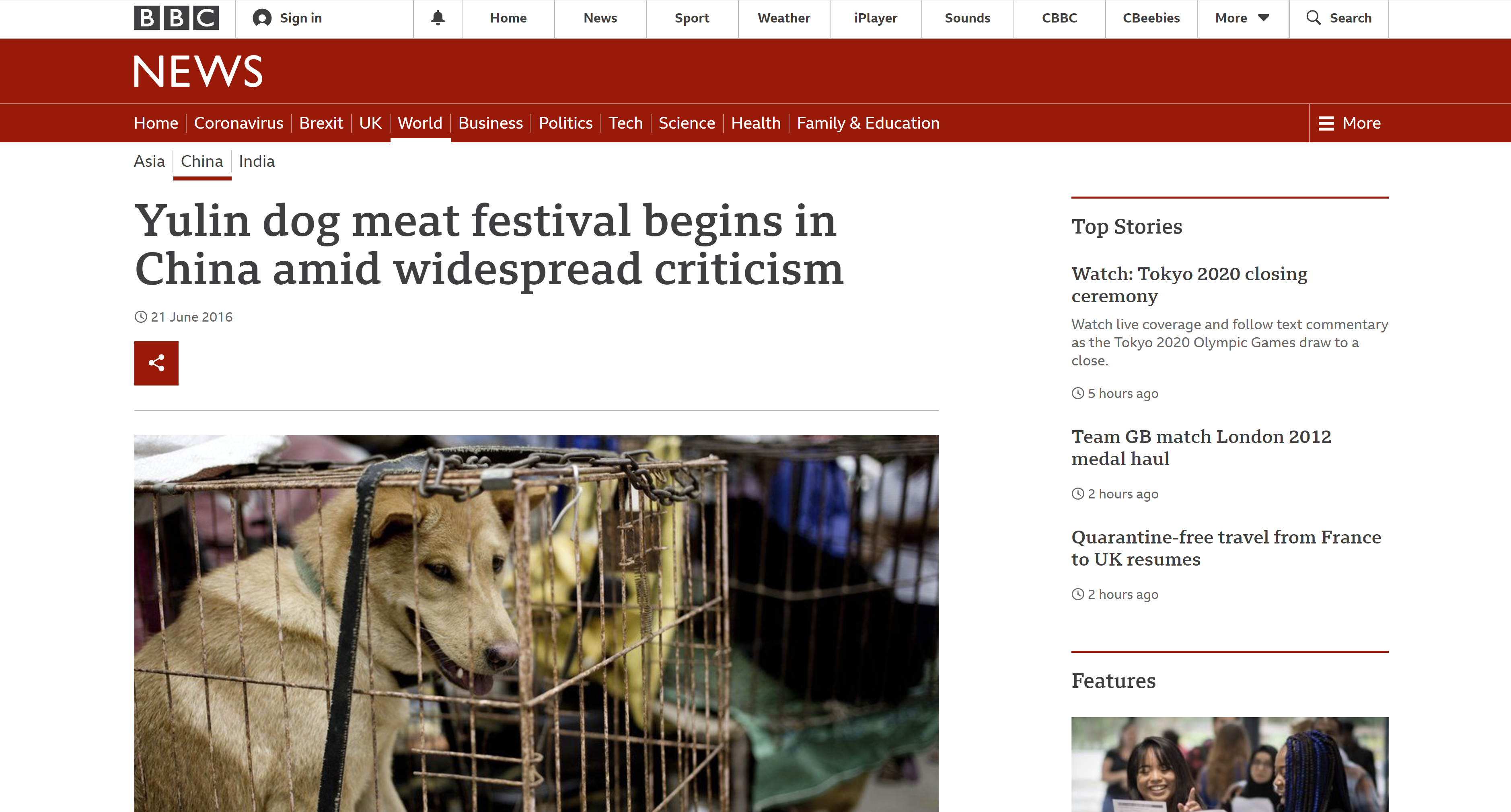
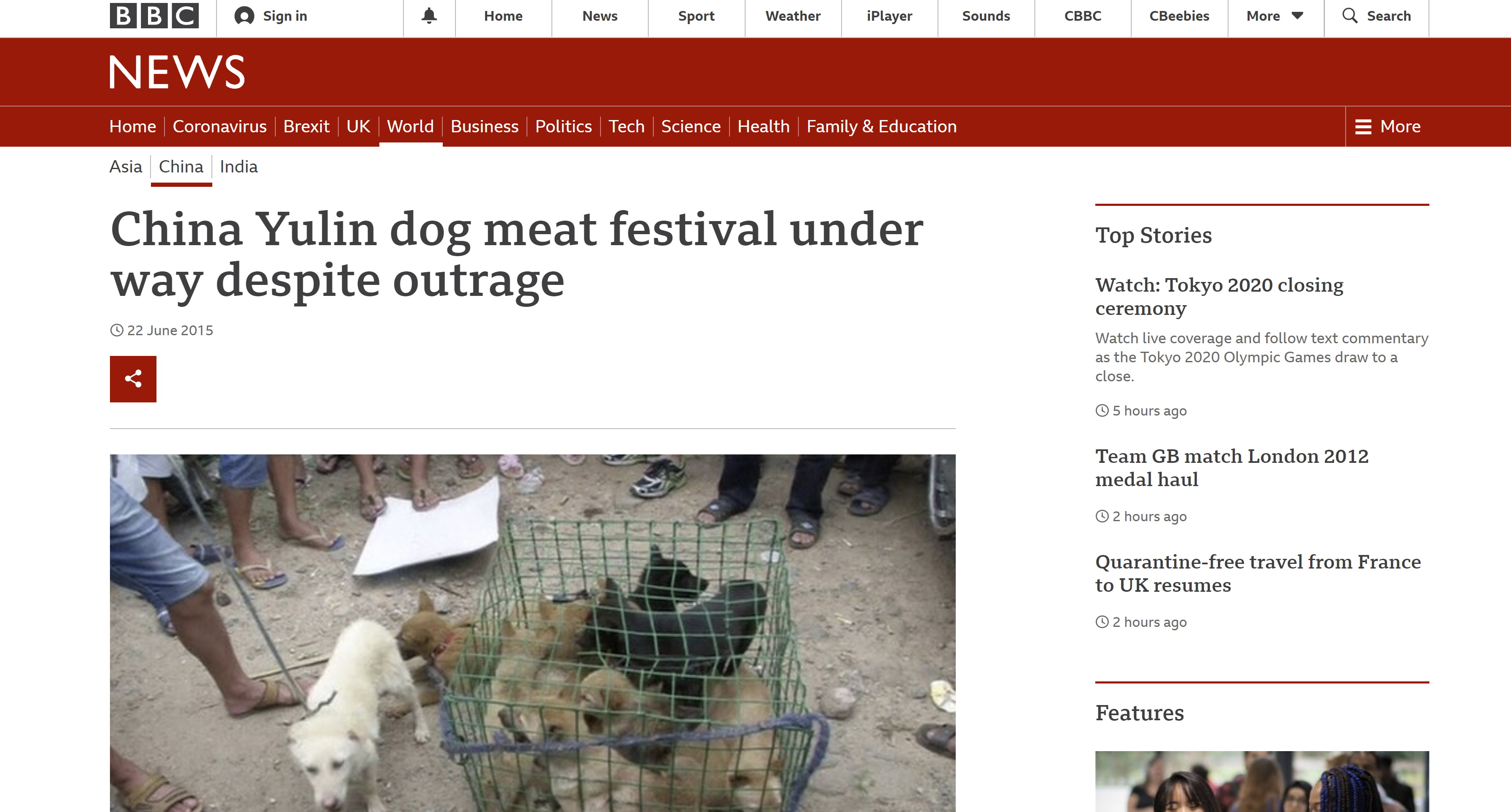
Patrick Thomas’ installation got me thinking about how news is reported and received dependent on the collective ethical and moral standards of isolated cultures. The Yulin dog meat festival in an interesting example of a controversial topic which is considered barbaric to most British people, however in Yulin, local opinions are divided between this being a valuable tradition and a outdated/ cruel practice with public health and criminal implications. The British reporting emphasises public opinion of outrage and criticism which reflects a western sympathy towards dogs as domesticated companion animals.
Semiotics analysis: I found the use of photography in the following BBC News articles interesting as they act as sign icons: The physical resemblance of the dog in conjunction with its position in the cage signifies that the dogs are trapped. The signified is further constructed dependent on our cultural perception of dogs and moral position on their use as companions rather than food. Ultimately our interpretation is shaped by the use of relay: the complementary relationship between text and image which helps to build two signifiers into a larger sense of narrative. This distinguished the cage as an instrument of possession and slaughter rather than of rescue as we would see in an RSPCA campaign.
I found it quite difficult to find articles and campaign material which expressed pro dog meat agendas, however I found it interested that articles containing global perspectives discussed the controversial topic more objectively and holistically considering arguments outside of animal welfare such as public health, theft, extortion and economical factors.
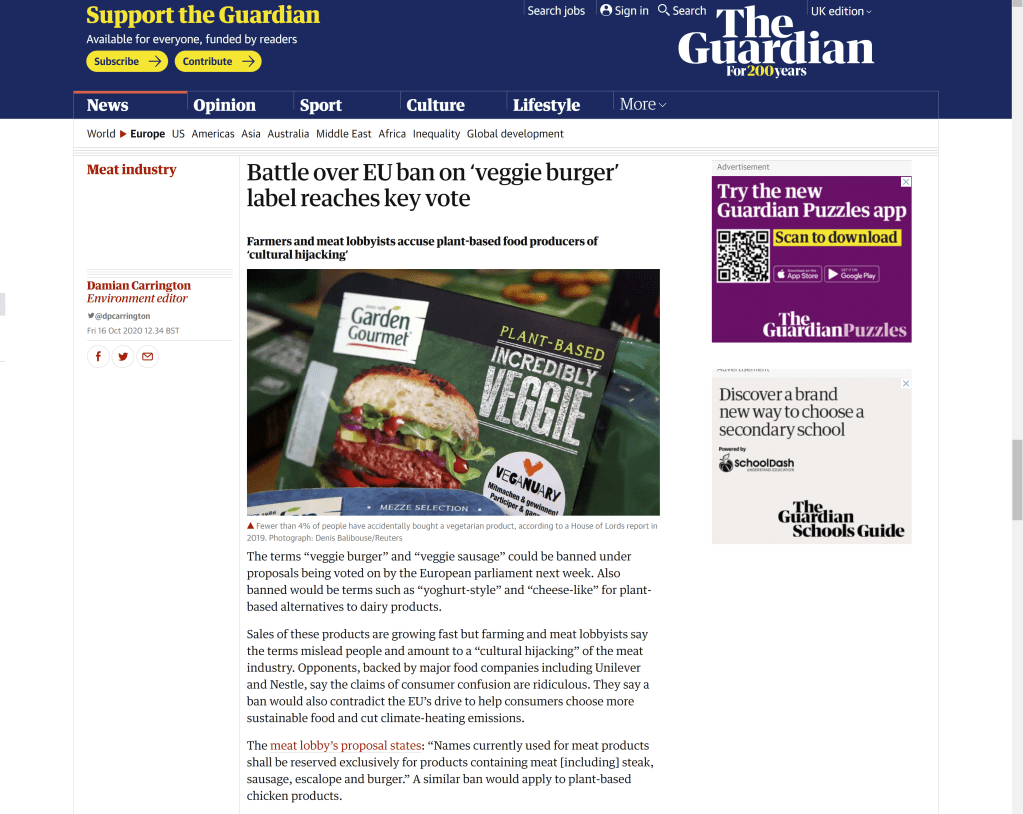
Patrick Thomas’ used of harsh black motion graphics, disrupting the text also got me thinking about the idea of censorship in the news. In contrast to mainstream reporting on animal welfare issues exemplified by the BBC, this PETA article represents an uncensored approach to anti dog festival campaigning:
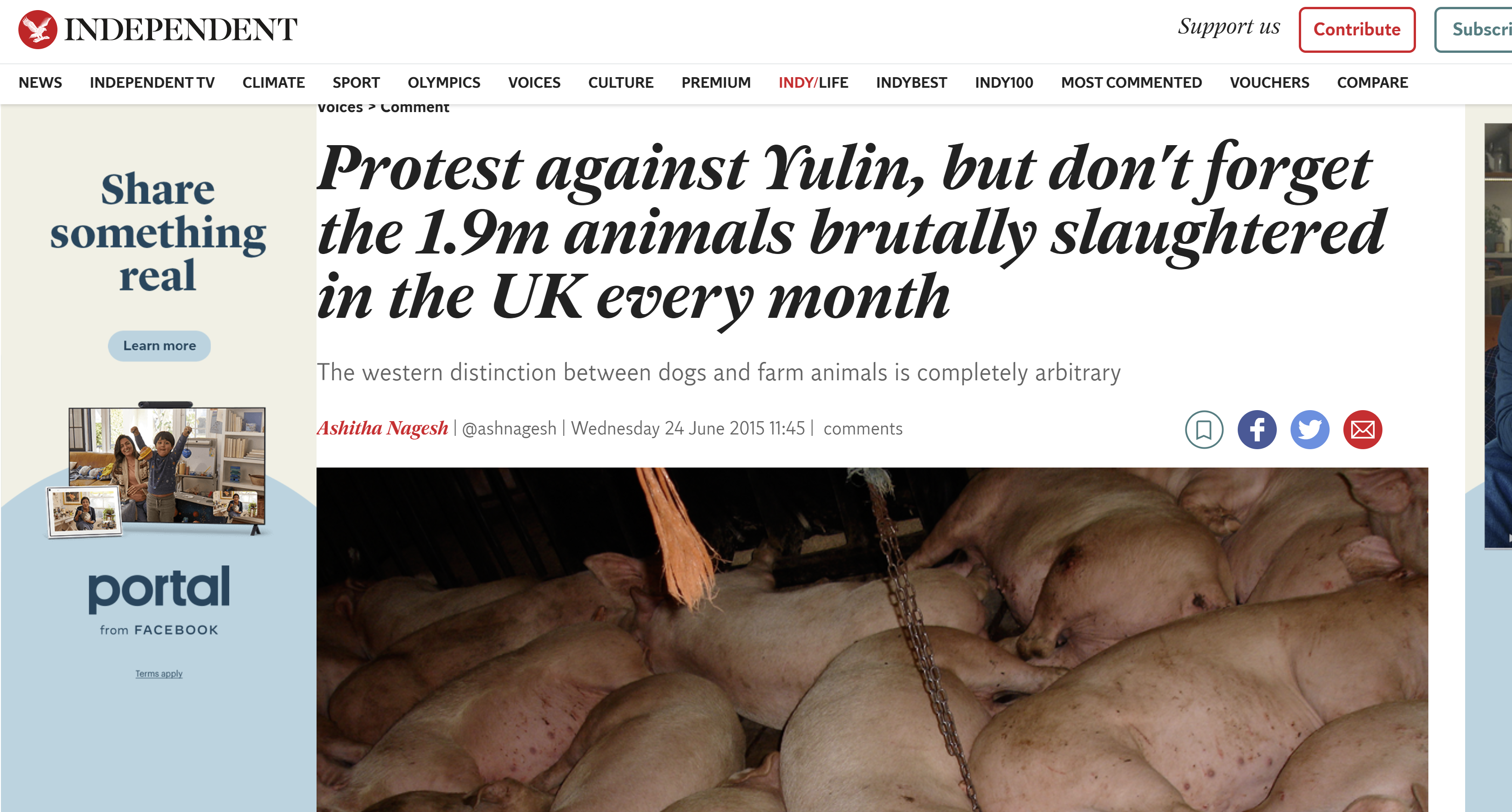
Considering variable cultural influences on how news is perceived, I thought that this article in the Independent strongly exemplifies the interplay between certain ideas and how conflicting narratives can inspire new opinions and debates within a global landscape.
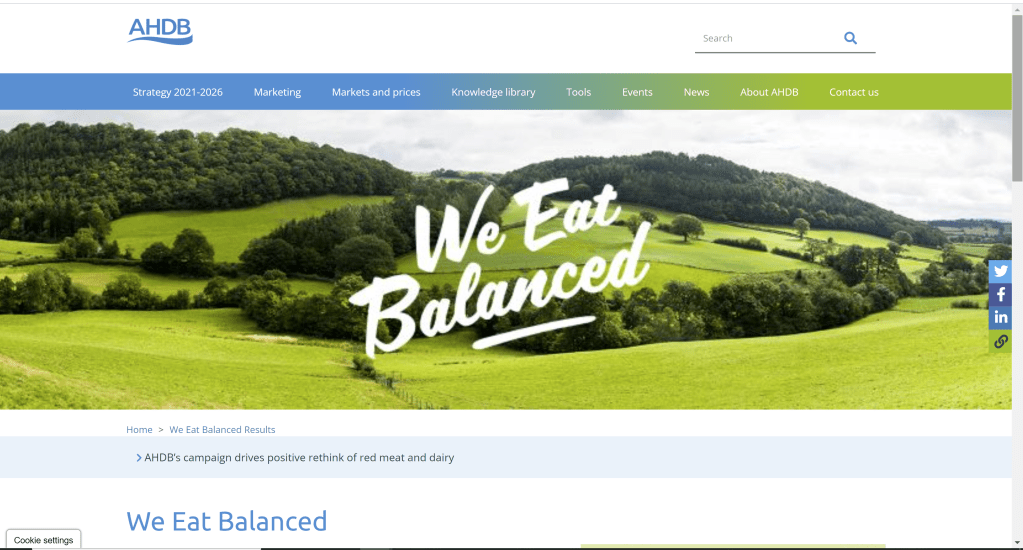
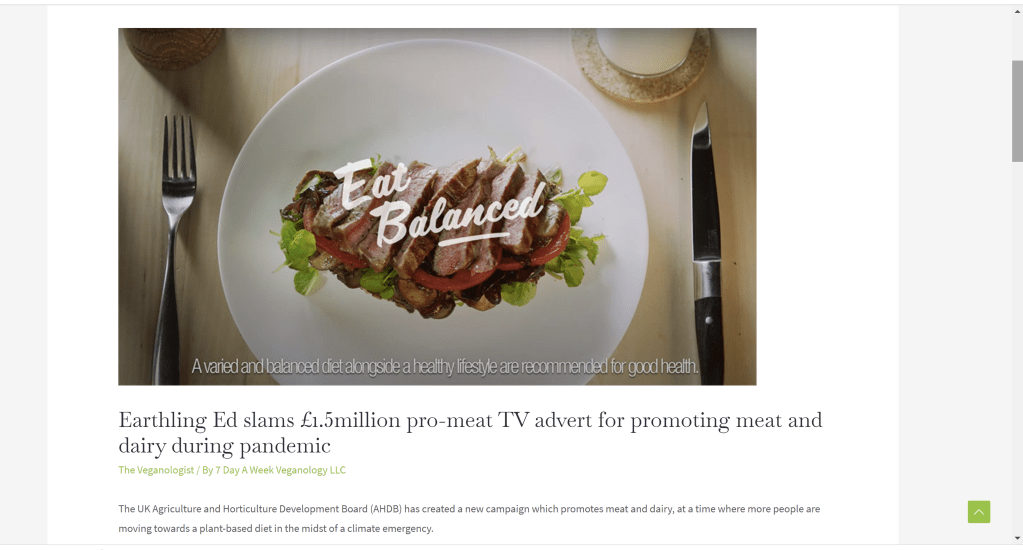
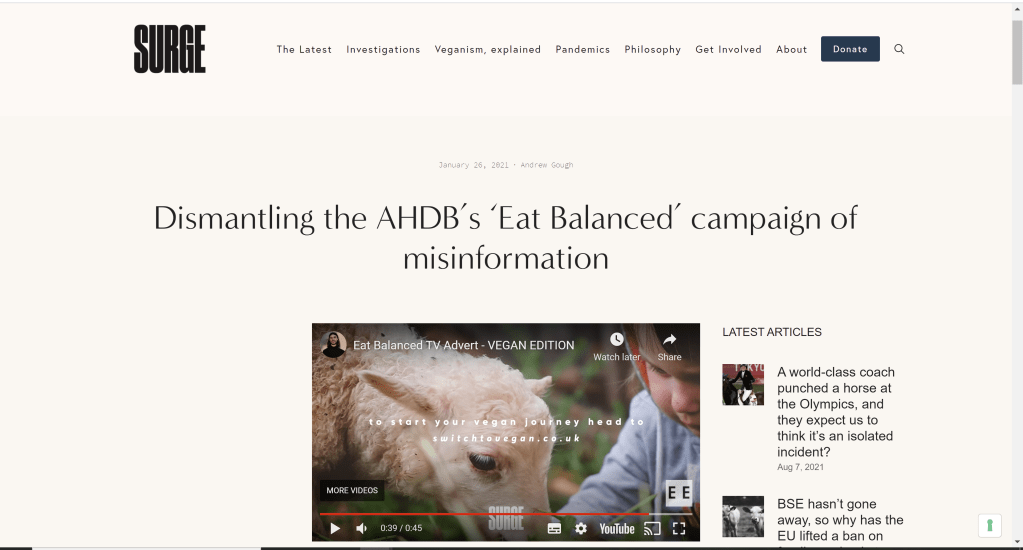
I then became interested in the political tensions regarding categories of ethical debate today represented in competitive campaigns which use satyr, imitation and bastardisation as a political marketing tool: An interesting example of this was the UK Agriculture and Horticulture Development Board’s (AHDB) ‘Eat Balanced’ campaign designed to tackle the reduction in meat eating. Due to the current climate emergency, this caused controversy within animal rights and environmental groups and was rebutted by Surge’s ‘Eat Plant Based’ campaign.
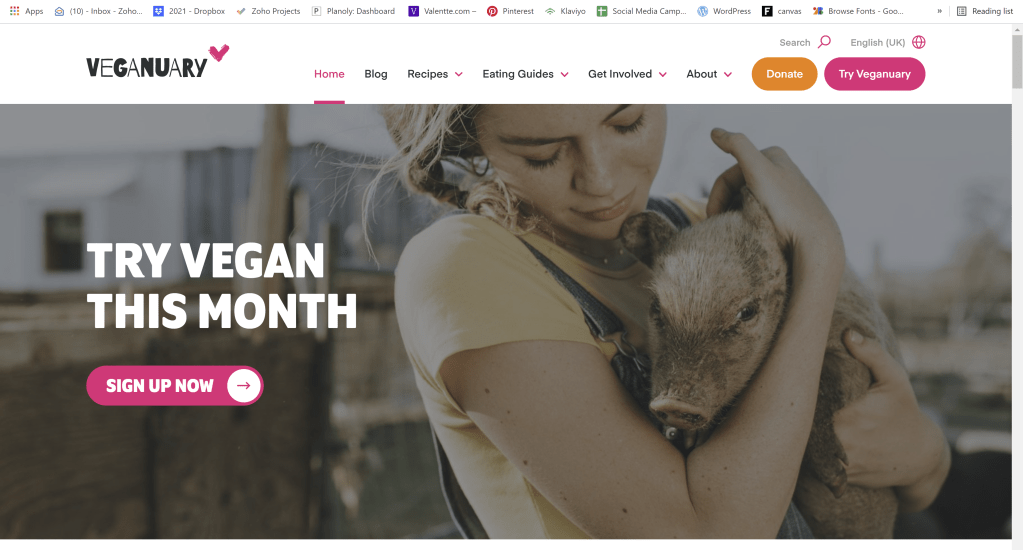
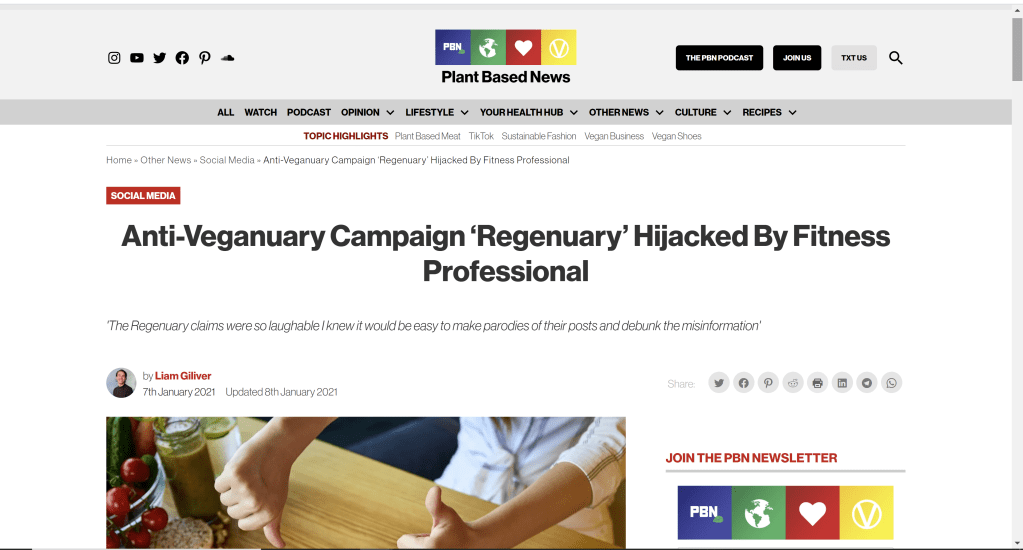
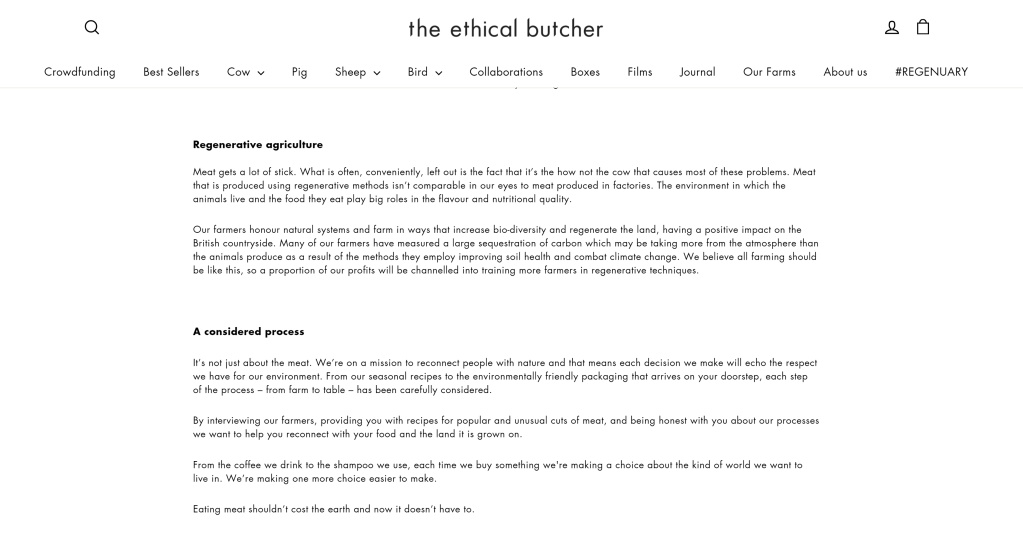
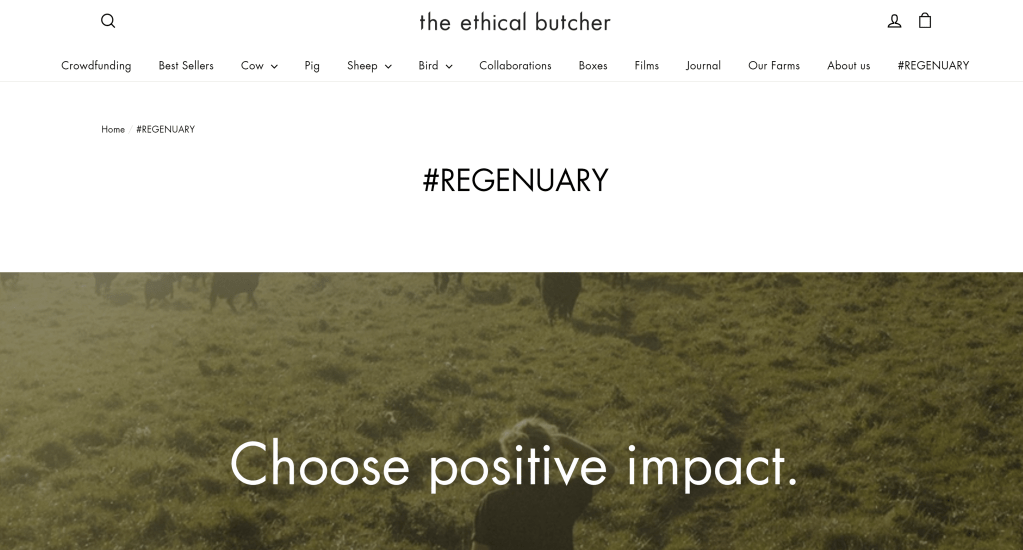
Similarly the semiotic understanding of the famous ‘Veganuary’ campaign has been hijacked by the philosophically opposed ‘The Ethical Butcher’ who advocated regenerative animal agriculture.

Heller S., (1999) Design literacy (Continued) Understanding Graphic Design. Allworth Press, New York.
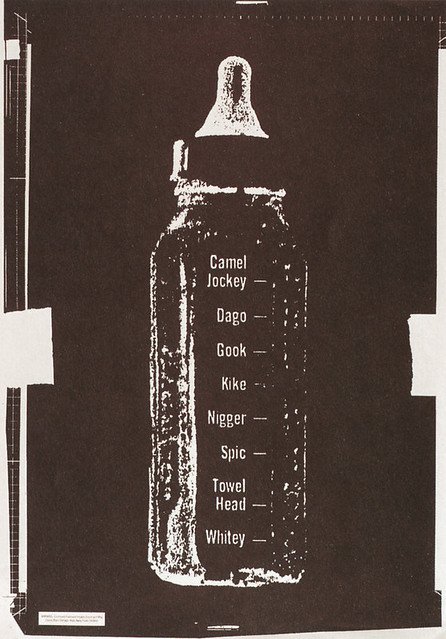
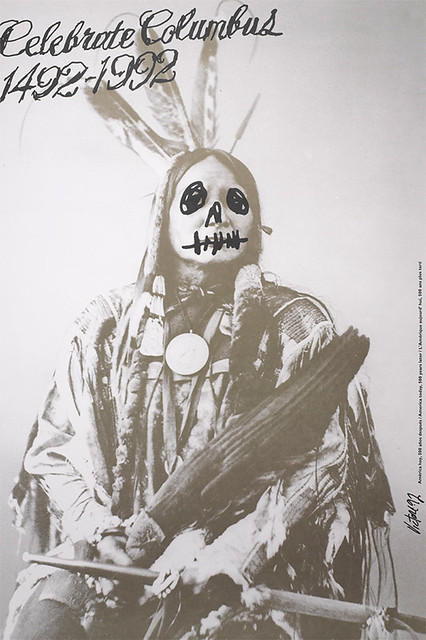
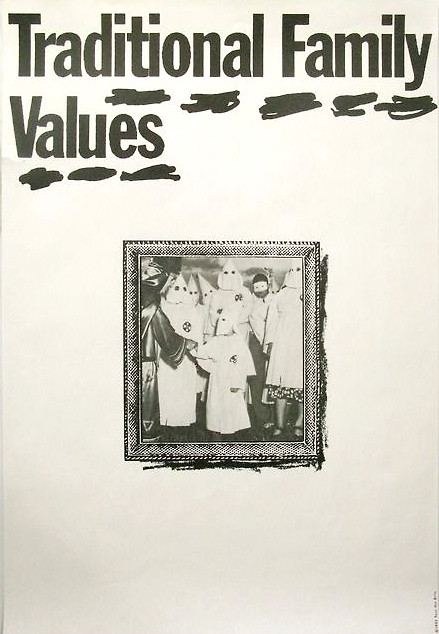
Steven Heller’s review of the work of James Victore deepened my understanding of design as activism and the practical aspects of getting a message heard through self initiated practice and sponsorship.
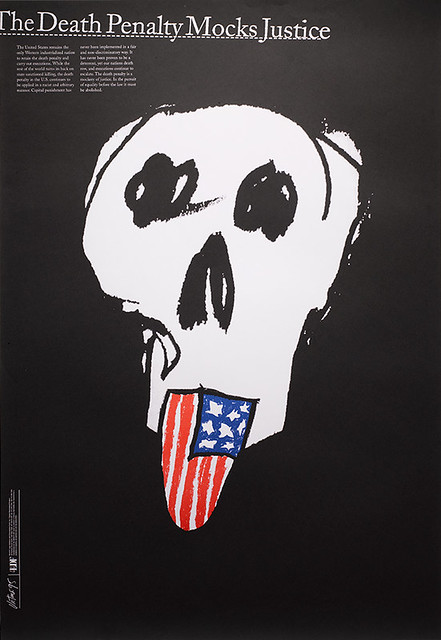
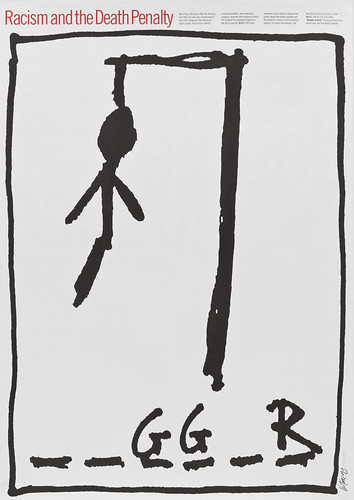
I was particularly inspired by the simplicity of Victore’s aesthetic approach which prioritises the communication of meaning over the exhibition of technical craftmanship: He uses intelligently constructed juxtaposed signs signifying confrontational political messages. For example, the meaning behind ‘Racism and the Death Penalty’, designed for a film tackling racial prejudice in the judicial system, is intelligible in the absence of the word ‘nigger’ which in conjunction with the insidiously innocent hangman game creates a sense of anxiety and anticipation which reflects the experience of death row.
“I could have come up with something more intellectual or some off beat imagery, but the problem was that for the people I was speaking to, I think it would have been too coy or too design-y… I want to speak in really simple forms and get an idea across in a gestalt manner, whether it’s through your heart or your intellect or whatever”.
I found the emphasis of social movements in Victore’s work extremely pertinent to my previous reflection on how the reception and construction of news stories are influenced by collective moral and ethical standards of certain locations and subcultures. In Heller’s study, this extends to varying levels of public awareness, for example in regards to the television of the 1993 Brooklyn Race Riots, Victore believed that “the the nightly coverage of had caused people to misconstrue the essence of racism. The physical spectacle was the main attraction, not the deep seated issues leading up to the hostility”. In other words, the media had failed to educated the public on the sociological cause of the event, and the symptomatic riots served a function to only feed “voyeurism of television news viewers”.
Contemporary examples of this can be seen in public reactions towards contemporary protests by environmental activist group, Extinction Rebellion (XR) who seek to disrupt daily life in order to raise public awareness of the climate crisis. Many interviews with XR representative seem to be dominated by questions regarding the ethics or effectiveness of the organisations protest style, rather than the subject of their activism.
For example, in Sarah Lunnon in a BBC interview responds to the topic of people ‘losing sympathy’ for XR due to it’s disruptive approach, “If we don’t act and protest this way, nobody takes any notice”.
Censorship:
The tension between censorship and free speech explored by Heller with specific regards to social movements such as civil rights and the sexual revolution gave me a fascinating insight into the behaviour of contemporary media. (For example, the previous reflection of explicit images of animal (dog) slaughter). Interestingly, Heller reveals that in modern American publishing, “controversial stories have been hacked and provocative artwork killed not because they were in bad taste but because some publisher fear an angry readership more than the ramifications of censorship”. The self censoring of organisations is therefore determined by what is socially palatable rather than what is legally responsible. In some ways the limitations of censorship therefore reflect the limitations of social progression, perpetuating outdated ideas.
Censorship war is also seen to occur between meat and dairy marketers and alternative plant based food producers. For example, the ‘Eat Balanced’ campaign was criticised by environmental activist groups for misleading information, and plant based food producers are being accused of ‘cultural hijacking’ for using terms such as ‘burger’ and ‘sausage’.
BBC (2016) Adam Curtis: Hypernormalisation [online video] Available at https://vimeo.com/191817381[Accessed 8th August 2021]
This documentary provided a fascinating perspective on how society has been manipulated through the creation and distortion of messages. Being interested in activism and social reform, I noticed similarities between contemporary subcultures and the individualised approach to self-expression over collective action in the creative arts following the 1975 financial crisis in New York which caused the state to be governed by the banks. Despite the existence of active protest, the aspiration to influence peoples minds through artistic expression seems extremely prevalent today in light of the climate crisis is an overwhelming feeling of mistrust or apathy towards political parties and large organisations to make effective ethical decisions.
The distribution and potency of power seemed to be an overarching theme of this documentary: I was particularly interested in how the internet became a vehicle to transcend the limitations of social hierarchy. Before VR, the screen ‘separated your mind from the mind of the computer’. The internet however reflected the human flaw, duality and incessant endeavour by becoming a saturated digital landscape facilitating corruption, crime, hate culture etc. eg. Acid freak, demonstrated the growing power and vulnerability of digital credit. (AI: Elisa – computer psycho therapist: virtual experience free of elitism, human judgement)
A Declaration of Independence of Cyber Space.
(Tron)
“Governments of the industrialised world, cyber space does not live within your borders. We are creating a world where anyone, anywhere, may express his or her beliefs, no matter how singular without fear of being coerced into … or conformity.
I declare the global social space we’re building to be naturally independent of the tyranny you seek to impose on us. We will create a civilisation of the mind in cyber space and may it be more humane and fairer than the world your governments have made before.
The fake UFO conspiracy and professional practice of ‘perception management’ further emphasised how our experience of ‘reality is managed by the government’, encouraging me even more to be politically sceptical. This idea is prevalent in western political responses to the collapse of the Soviet Union; the post political world evolved from the idea that politics can be used to create a new world to a distrust towards politics routed in idealism or reformation. Beck: runaway world: politicians believing that they could drive social change were dangerous – they instigated unexpected outcomes and therefore politics should function instead to manage risk and keep society stable. Perhaps this contributes to an apathetic perception that politics rarely embraces change as it is conscious of unpredictable radical ideas?
AI: Intelligent agents predicting what people want in the future – what content people want to see. Does this limit peoples experience of the world by only showing them what they already like and agree with? People need to be exposed to the controversy in order to form objective opinions. This is evident in the election of Donald Trump.
Chemical Weapons: The Human Bomb
I was fascinated by the theological origins and motivations behind the evolution of suicide bombing and how certain theological strands of Islam were manipulated by political leaders to create the concept of the ‘poor mans atomic bomb’. The history behind global politics gave me a much more nuanced understanding of terrorism and how events like 911 were able to reposition the perception of terrorists into something senselessly evil.
Workshop Challenge:
Research


Ideas Wall:
Case Study 1:
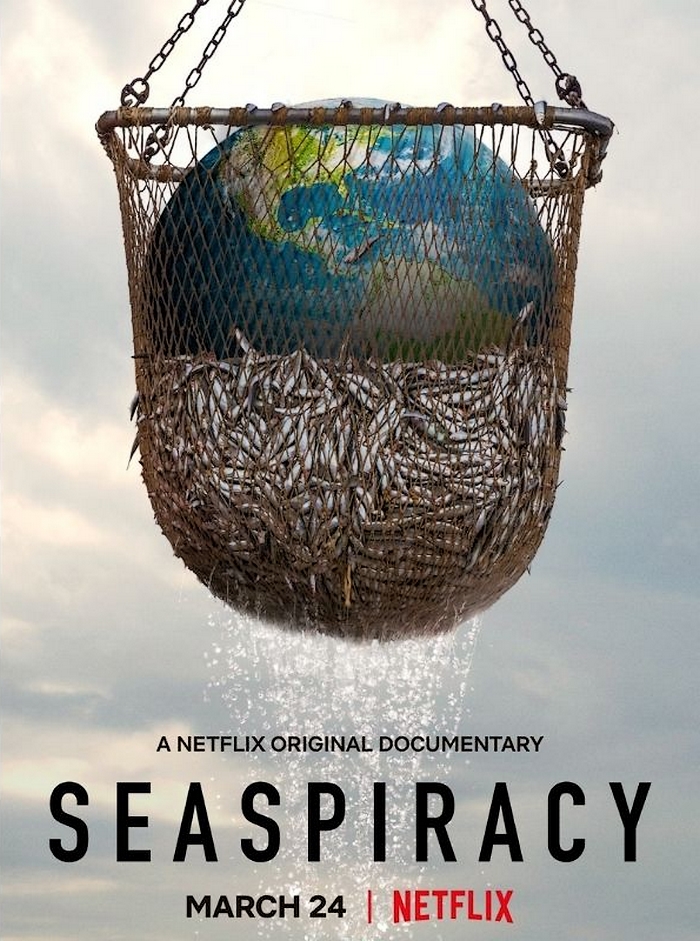
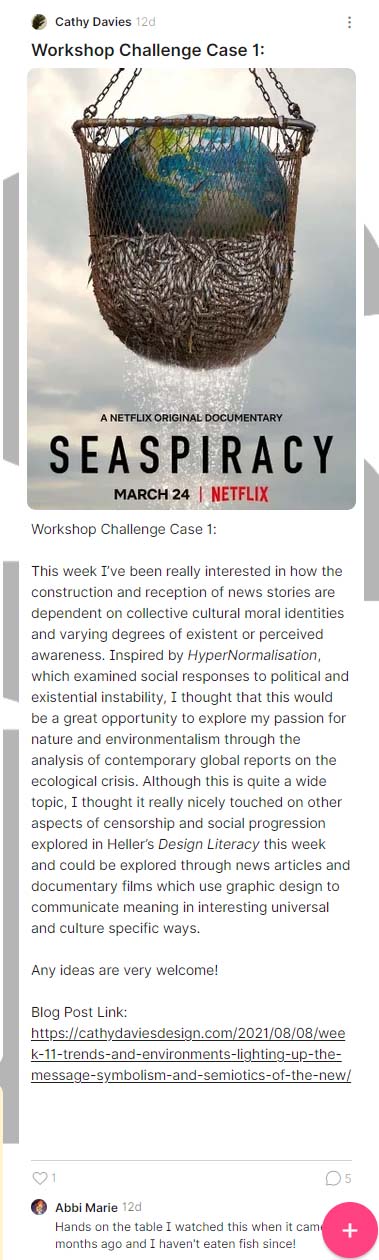
Seaspiracy (2021), directed and produced by British filmmaker Ali Tabrizi 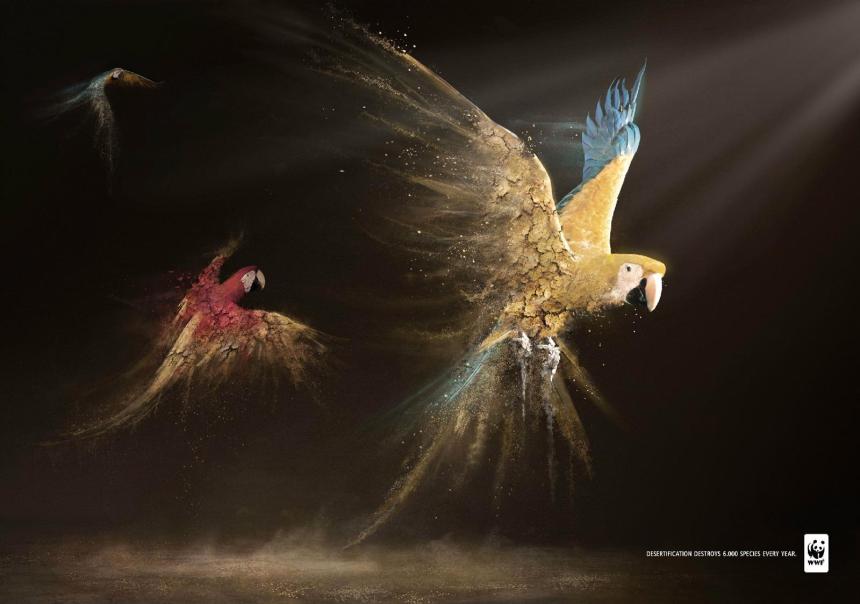
WWF’s desertification campaign (Contrapunto BBDO agency of Madrid, Spain) 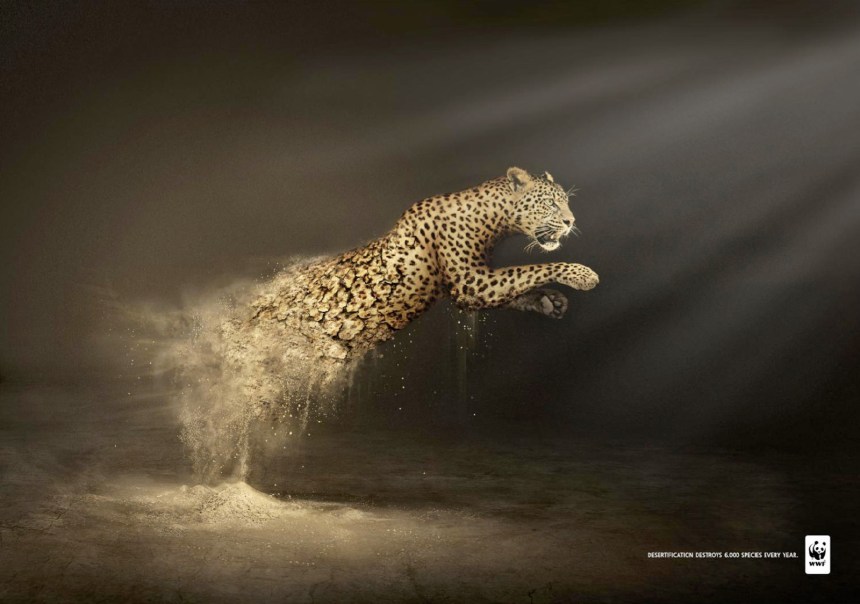
WWF’s desertification campaign (Contrapunto BBDO agency of Madrid, Spain) 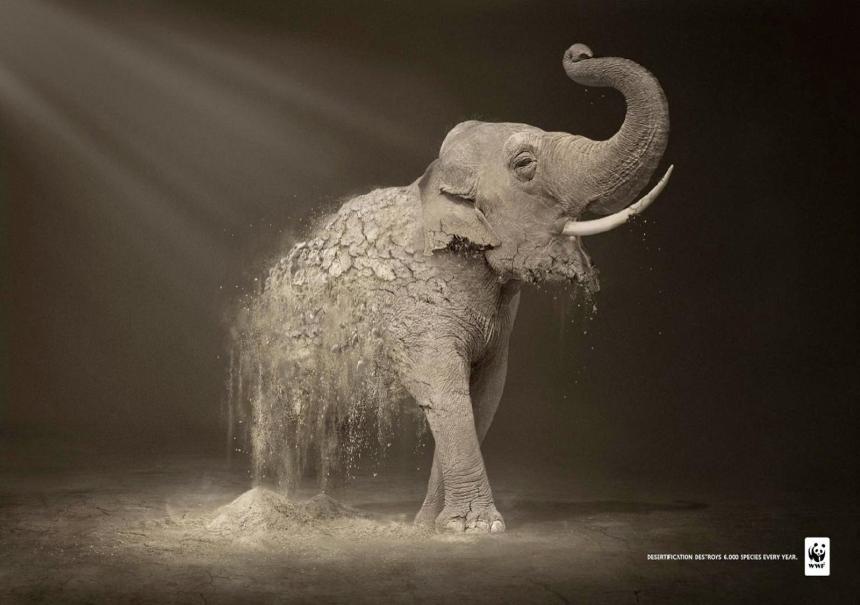
WWF’s desertification campaign (Contrapunto BBDO agency of Madrid, Spain) 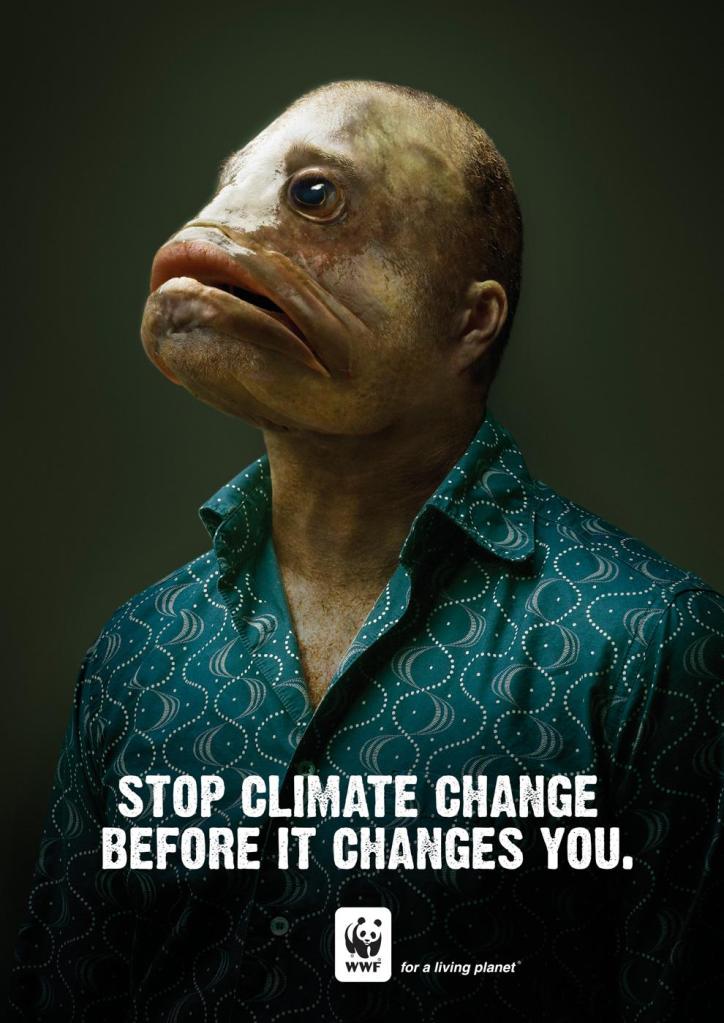
WWF’s ‘Stop Climate Change Before it Changes You’ campaign (Germaine ad agency, Belgium)
The biodiversity crisis is a global issue which threatens the existential stability of our planet and encompasses a plethora of human causes. International media employs a multitude of semiotic constructions to reposition social perceptions of planetary issues and generate awareness, alternative consumer behaviours and financial and political support.
The British documentary film Seaspiracy (Tabrizi 2021), challenges the notion of sustainable industrial fishing practices using data and explicit footage to expose the industry’s environmental impact. Interviews with influential figures such as George Monboit, reveal statistics inviting the viewer to reflect upon their impact as consumers. For example, ‘46%’ of oceanic plastic pollution is caused by commercial fishing nets’ and ‘long line fishing sets enough fishing lines to wrap around the entire planet 500 times every single day.’ The vastness of plastic use is signified through animated infographics; the earth is represented as a sign icon, using its physical resemblance to communicate scale, whilst the animated fishing line signifies the amount of plastic used in relation to the earth. The use of relay between text, narration, numerical data, figurative imagery and real word footage consolidates multiple signifiers into a wider, hard-hitting narrative which interconnects pollution, animal welfare and consumer responsibility.
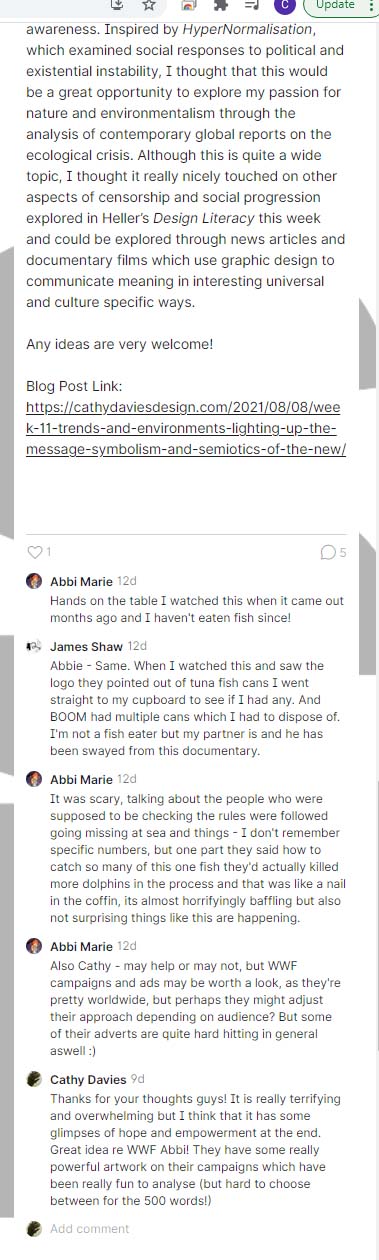
Typographic transitions and digital sound effects reflect the conventions of horror, complimenting the chronological narrative style which enables the viewer to experience the unravelling of information from the film makers perspective. This generates trust towards his experiential journey. Peer discussion revealed the documentary’s effect on the individual and how it influenced immediate lifestyle changes.
‘I haven’t eaten fish since!’ – Abbi Marie.
‘When I watched this and saw the logo [dolphin safe] they pointed out on tuna fish cans I went straight into my cupboard to see if I had any. And BOOM had multiple cans which I had to dispose of.’ – James Shaw
James’ experience demonstrates how brand identity can be recontextualised to adopt antithetical connotations. In the context of empirical and primary data on bycatch, the ‘dolphin safe’ logo, once a signifier of ethical reassurance, became a symbol of corporate corruption, violence and hypocrisy.
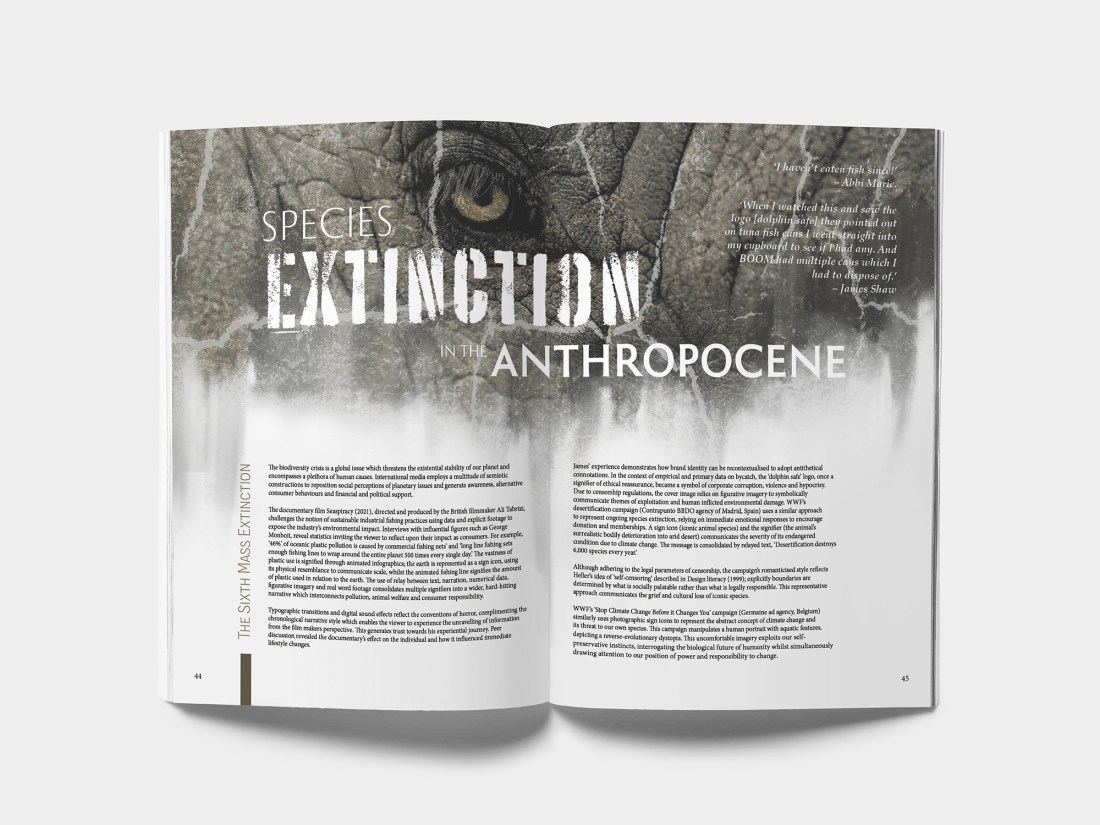
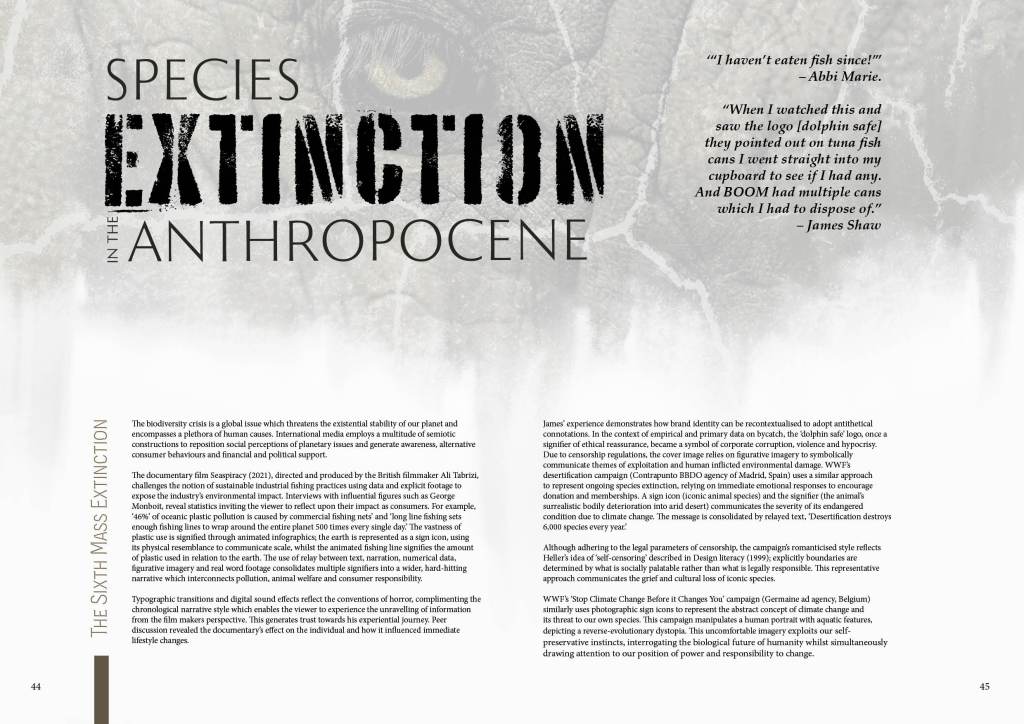
Due to censorship regulations, the cover image relies on figurative imagery to symbolically communicate themes of exploitation and human inflicted environmental damage. WWF’s desertification campaign (ADS OF THE WORLD. 2011 ) created by Contrapunto BBDO agency of Madrid, Spain, uses a similar approach to represent ongoing species extinction, relying on immediate emotional responses to encourage donation and memberships. A sign icon (iconic animal species) and the signifier (the animal’s surrealistic bodily deterioration into arid desert) communicates the severity of its endangered condition due to climate change. The message is consolidated by relayed text, ‘Desertification destroys 6,000 species every year.’
Although adhering to the legal parameters of censorship, the campaign’s romanticised style reflects Heller’s idea of ‘self-censoring’ described in Design literacy (1999); explicitly boundaries are determined by what is socially palatable rather than what is legally responsible. This representative approach communicates the grief and cultural loss of iconic species.
WWF’s ‘Stop Climate Change Before it Changes You’ campaign (ADS OF THE WORLD. 2008.) by Germaine ad agency, Belgium similarly uses photographic sign icons to represent the abstract concept of climate change and its threat to our own species. This campaign manipulates a human portrait with aquatic features, depicting a reverse-evolutionary dystopia. This uncomfortable imagery exploits our self-preservative instincts, interrogating the biological future of humanity whilst simultaneously drawing attention to our position of power and responsibility to change.
References
TABRIZI, Ali. 2021. Seaspiracy. [Film].
ADS OF THE WORLD. 2011. ‘WWF Parrots Campaign’. Ads of the World [online]. Available at:
https://www.adsoftheworld.com/media/print/wwf_parrots [accessed 4 July 2017].
ADS OF THE WORLD. 2008. ‘WWF Fish’. Ads of the World [online]. Available at:
https://www.adsoftheworld.com/media/print/wwf_fish_0 [accessed 4 July 2017].
HELLER, S. (1999) Design literacy (Continued) ‘Understanding Graphic Design’. Allworth Press, New York.
Editorial Review
Research
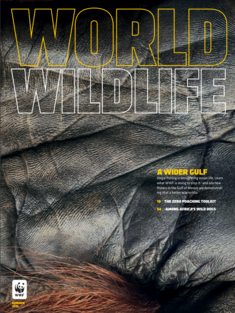
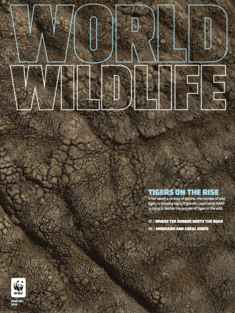
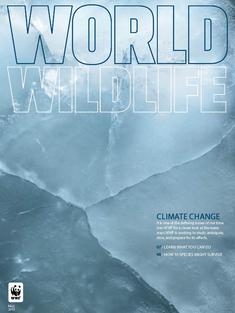
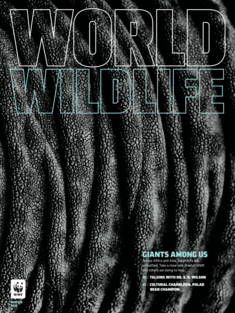
Development
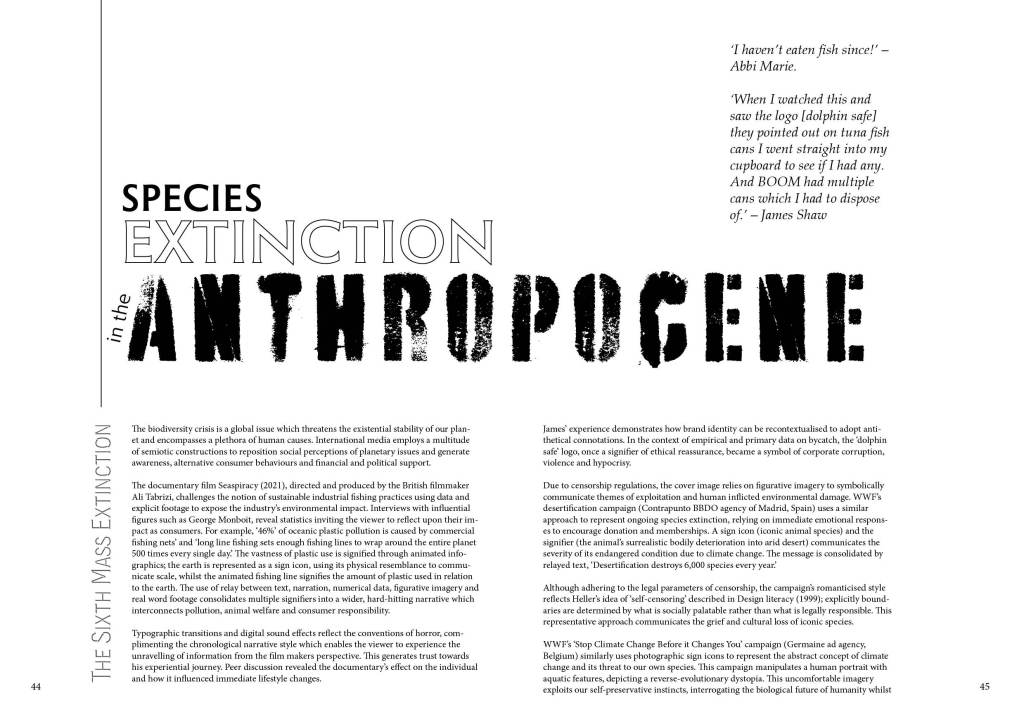
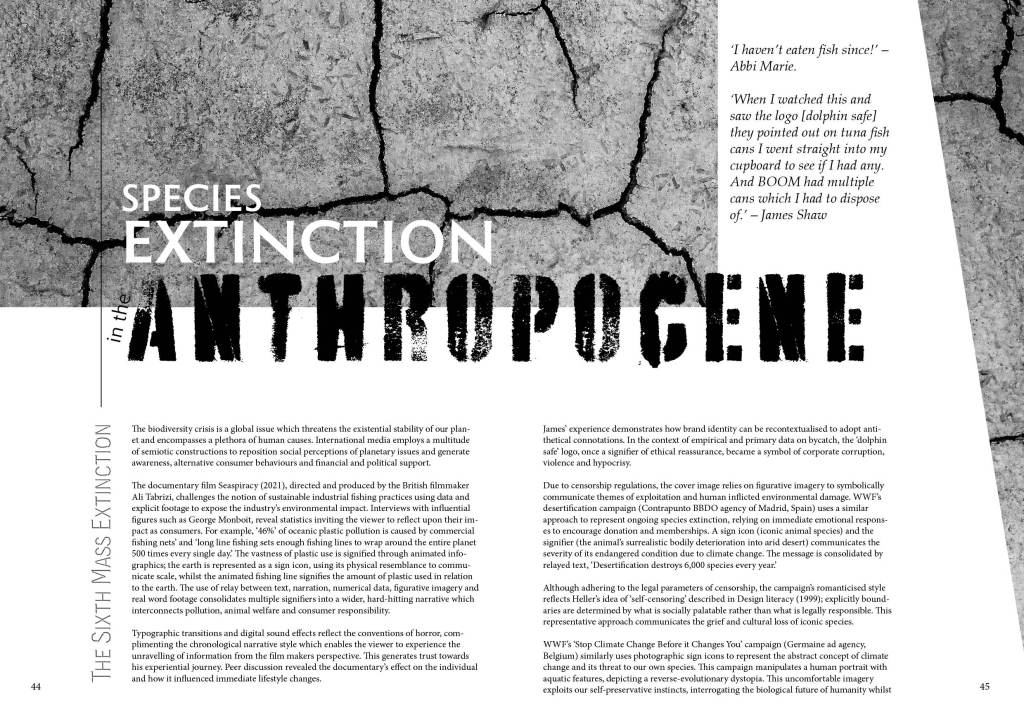
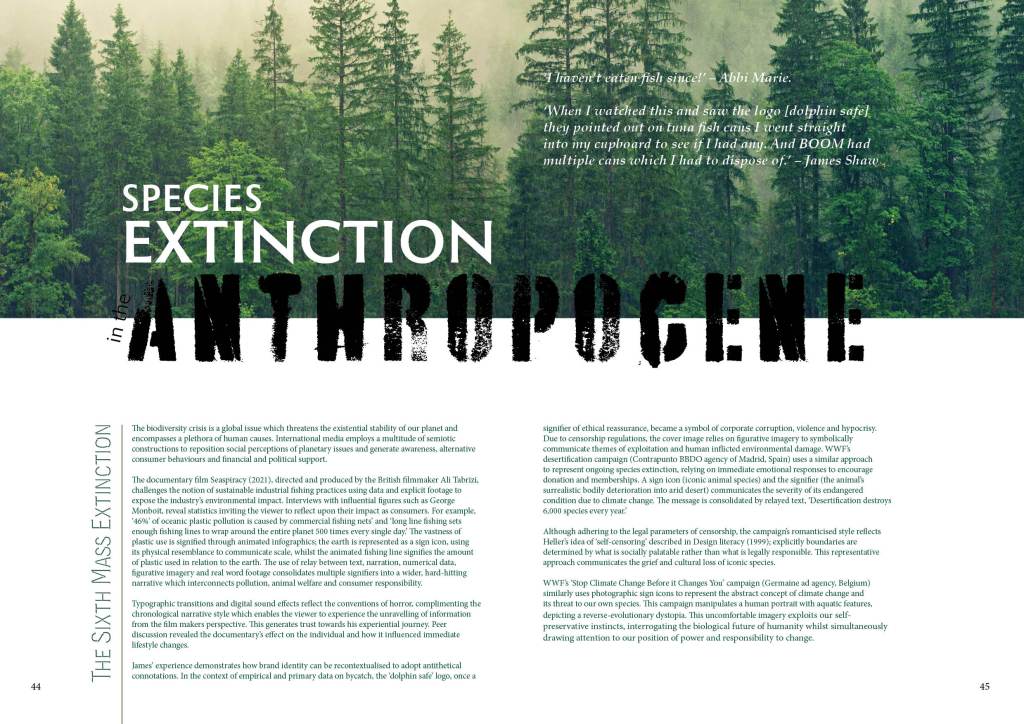
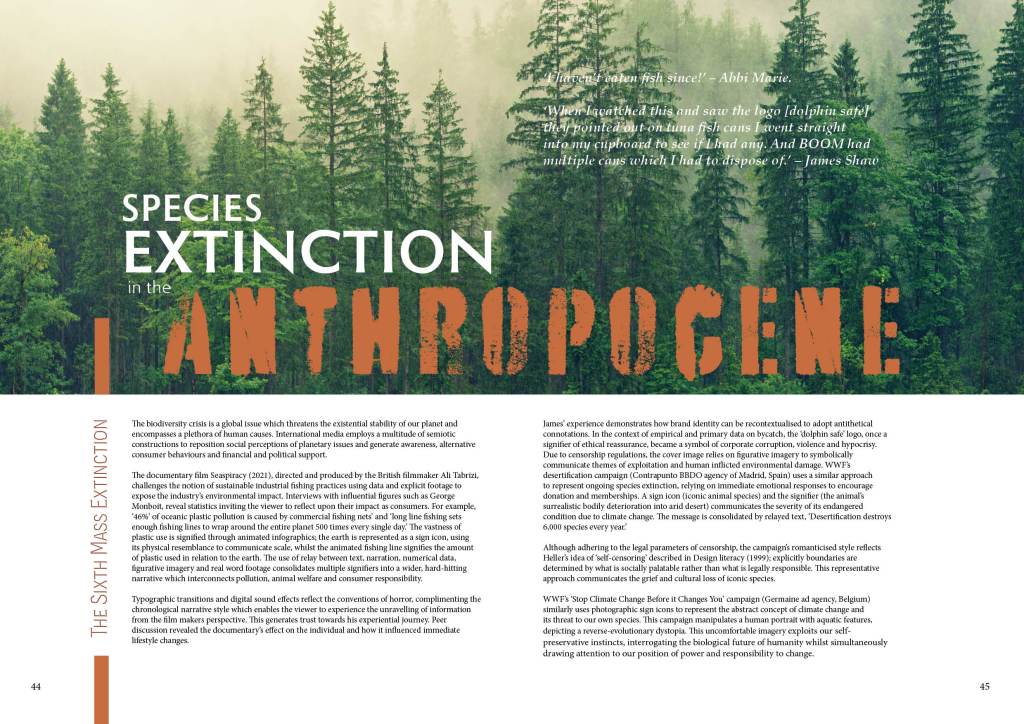
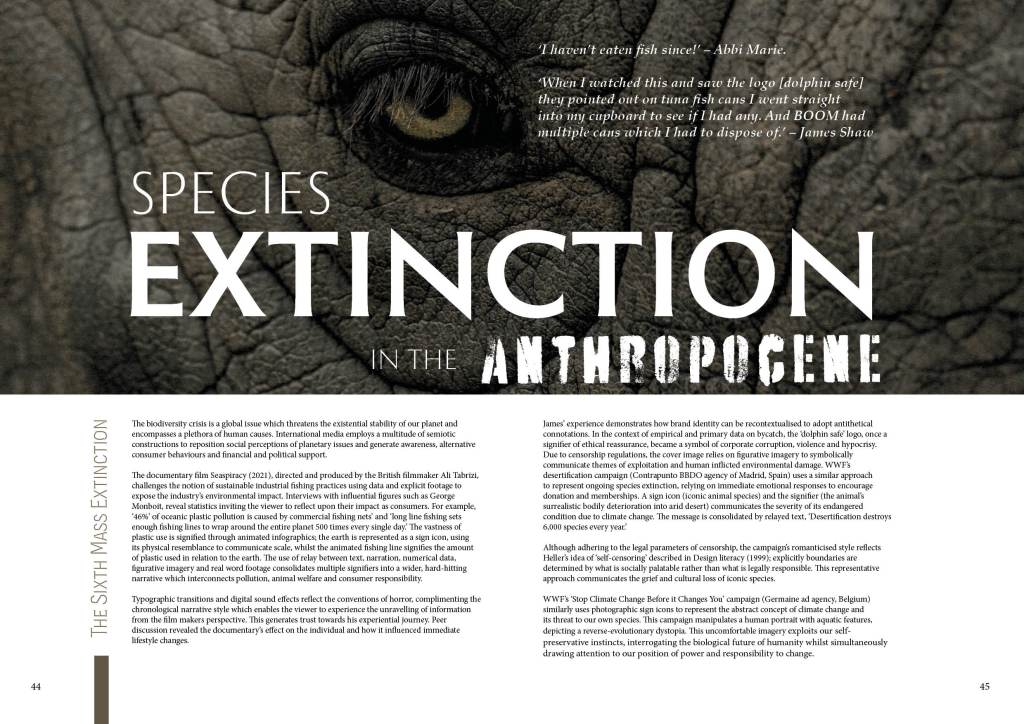
Final Outcome
Critical Reflection
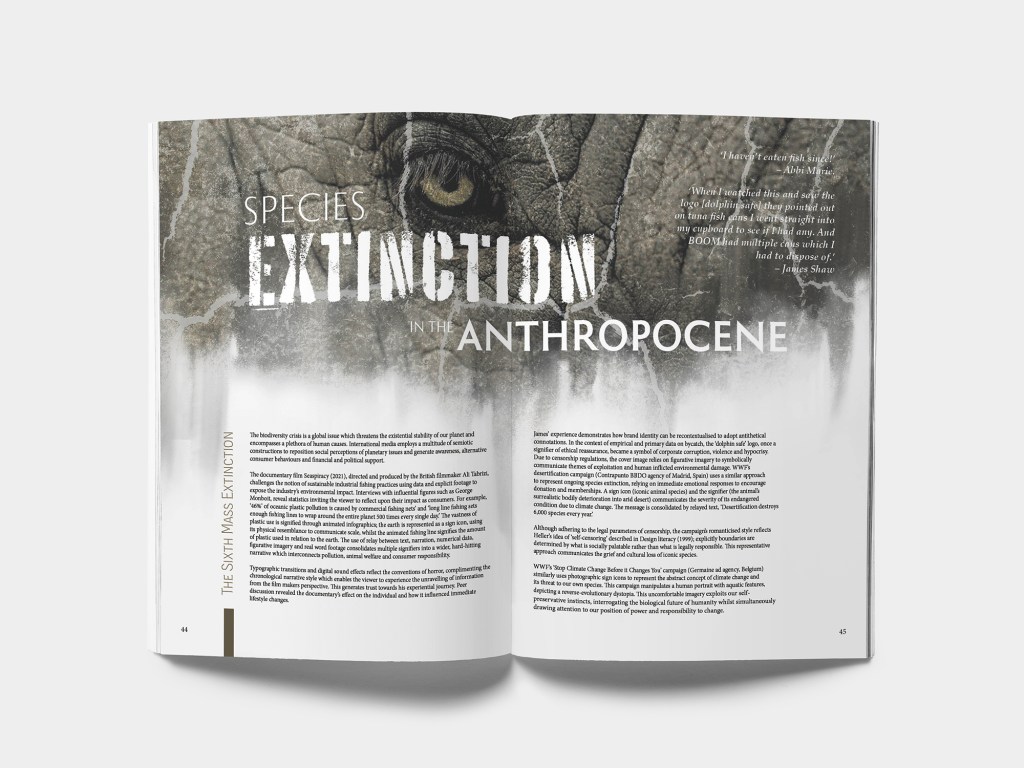
After experimenting with multiple textures and images to visually communicate the subject of species extinction, I decided that a photographic representation of an iconic animal, particularly with close up facial features, was necessary to create emotional reactions of empathy and cultural loss.
The combining of images to create emphatic textures conveying disappearance and fragmentation was heavily inspired by the WWF’s desertification campaign which uses symbolism and metaphor convey the complex abstract concept of biodiversity from a perspective of loss. The transitory process of disintegration acts an emotive call to action to the public to intervene as the subject, although critically endangered (or metaphorically disintegrating) is still present, emphasising the potential for hope. The final composition is informed by the semiotic relationship between relatable, familiar sign icons (the elephant) and signifiers (such as the images deconstruction) to signify a conceptual threat to the animal. Having analysed the use of text relay in previous reflections this week, I wanted to use a rough typeface to consolidate underlying meanings of existential threat. I feel that when applied to the triggering cultural word ‘EXTINCTION’, this creates a dystopian tone of voice, connoting activism and anti establishment demands for systemic change in environmental policies which we are seeing today.
In hindsight there is room to be more illustrative and experimental with body type setting in a way which conveys the fragmentation and instability of biodiversity, for example, the copy could be set in a descending geometric layout connoting the idea of decline and disappearance. If I had more time also I would have experimented more with effects in photoshop to disrupt the image in meaningful ways, as I feel that it could more strategically and thoughtfully interact with the editorial layout.

 CATHY DAVIES