
Walker Art Centre (2011) Graphic Design: Now in Production.
- Using tools to design tools
- Busy Town
- Evolution of tools
- Devaluation of tools due to automated
- Self publishing = publishing the self
- Logos: importance of brand identity the business of doing unique things – “fulfil the human need to be surprised”
- Mad Culture; Jeremy Lesley: printed magazines
Ian Albinson: Art of Titles
- Opening title sequence
- Saul Bass – Hitchcock
- Makes title cards unique part of film
- To Kill a Mocking Bird
- Richard Greenburg – digital title sequences
- 80s branding and logo approach
- Resonates with the public
Karen Fong: Title Design:
Taking ideas and making them into an icon – greater symbol of the themes
Design and language:
- How can language and technology be an impetus for gd?
- Metalanguage – Noam Chomsky
- Phonemes and morphemes
- Recursion imbedding a sentence within a sentence
- Enable to describe infinite concepts – systems in design methodology
- Political dimension of graphic design
- Expanded practice of design
- Participatory space
- Contemporary cultural conditions
Critical reflection:
Title design:
Dominion (2018 Documentary) | Trailer
Hogwood Pig Farm 2018: Viva! Vegan Charity Documentary Trailer
Fictional Narratives
The Herd, Jennie Richards (2015)
CARNAGE : Swallowing the Past (2017)
BBC mockumentary looking at the history of Veganism from the founding struggles of 1944 leading up to utopian 2067 – Created by Simon Amstell.
Further title design research and inspiration:
Ambrose, G (2014) ‘Design Genius. The Ways and Workings of Creative Thinkers (Links to an external site.)’, London, Bloomsbury.
Narrative:
“Design may contain an aesthetic narrative whose sole function is to fulfil a role that is fundamentally important to the perceived nature of an item. For example, car manufacturers are producing electric sports card that are approaching the performance characteristics of petrol-powered cars. Their designs are having to incorporate airflow mechanisms or other artificial means of generating the engine ‘howl’ sounds that electric car engines do not produce as they accelerate, as engine howl is part of the narrative that the purchasers of sports cars want.”
The idea of consumer relationships with the narrative behind certain products can also be applied to the plant based food markets requirements to in some way, simulate the traditional culinary experiences in order for the consumer to retain its sense of cultural identity with regards to the ritual of meat and dairy eating. With regard to the ethical plant based eater, this does not just enable individuals to experience plant based versions of their favourite foods, but it allows them to partake in important social and cultural traditions and not be alienated in communal dining contexts.
In Conversation with Vince Frost on Sustainability and Creating Experiences
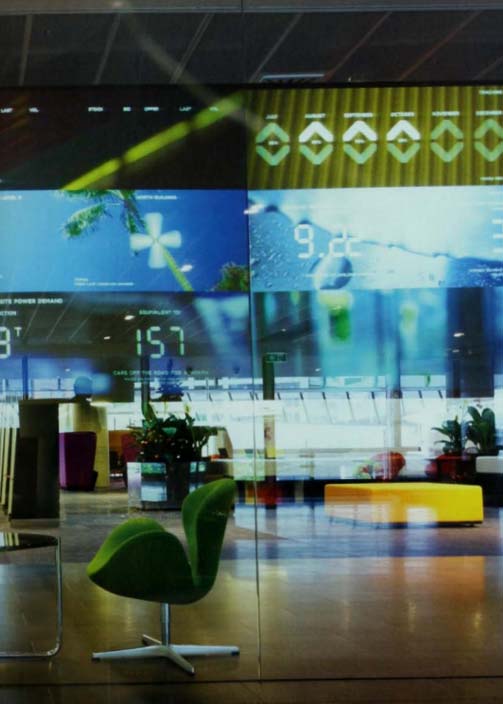
Discusses how the realm of graphic design has changed and so has the “notion of what is a surface”: The Commonwealth Bank Australia (CBA) Darling Walk created by Vince Frost, featuring an integrated signage and wayfinding system that communicates sustainability information in real time to inform visitors and staff of CBA’s efforts to minimize its environmental impact.
“For the digital wall we created a theme of ‘DataFlux’ which means everything changes. How do you create typography that is continually changing? We created lenticular meeting room walls that create movement as you navigate around them, creating the idea of a culture of change, that things are non-static, the experience of surprise and change”.
I really like the transitory experiential nature of this project and how it expresses cultural transformation. This inspires me to think more broadly not just about how moving image, motion graphics and film can be used as media through which to explore my research question, but how such design outcomes can be put into unconventional contexts to create new experiences for the viewer and challenge the boundaries of what graphic design is and how it operates within various contexts.

Sustainability – Paul Hawken
“Design plays a fundamental role in sustainability because it is the design that determines which resources are employed and how they are used. Designing with sustainability in mind can lead to reductions in resource consumption, changes in behaviour, and a greater utilization of sustainable resources. Sustainable design aims to eliminate negative environmental impact by completely through skilful, sensitive design. Within the context of sustainability design has various realms of influence. It can educate and help change opinion by communication information about environmental impacts and patterns of consumerism”
Joao Nunes on the role of the graphic designer in relation to the environment.
- “As to the the theme of social responsibility, design is now, more than ever, essential to refocus the discipline”.
- “The manipulation of perception is one of the most powerful weapons of destruction at the service of a consumer society that has built the world we live in”.
- “We didn’t take care of the ethical values inherent to the profession. Therefore the designers have contributed greatly to the current state of chaos in which we find ourselves. Nevertheless, there are strong indications that the designers who helped cause this problem will also be an active part in its resolution”.
Politics and Design:
“Political designs tend to appeal to our emotions with images that bring to the fore our hopes and aspirations or that seek to capitalise on our fears. In both instances, they seek to reinforce and enhance our emotions, whether positive or negative”.
In the Pacific Front of the Second World War, both Japanese and American combatants presented their opponents as non-human or subhuman to dehumanise the killing – also applicable in Nazi propaganda with regard to manipulated public perception of the Jews. Collective stereotypes were used to detach from the individual and justify brutality. This could also be applied to marketing of food which presents idealised images of food animals to distract the consumer from the individual experience of the animal as a sentient being with its own internal experience of self and the world.
eg. “Companies spend large sums of money to create brand imagery that projects the attributes that they want to be seen to possess: global reach, dependability, exclusivity and so on. Conversely, groups like Adbusters or street artists like Banksy use design to subvert the same messages and tell a different story, to peak beyond the corporate veil’: trademarks, icons, labels and the feel good factor in marketing design.
Design is also used to ‘heal wounds’: Dadaism (1916 – 1920) aimed to shock people with its irreverence for established social norms.
“Design is political because it has consequences, and sometimes serious ones. The power of design is that we can design things to have different consequences.”
Jennie Winhall
Robbie Conal: Guerilla Poster Campaigns
“How does a funky little artist express himself in public about stuff he cares about?”
Shephard Fairey and Mear One: series of anti Iraq ware, anti Bush posters: “Joining the democratic dialogue was the goal but not changing peoples minds. That is where street art becomes propaganda”. – The boundaries between political art and design and propaganda seem quite difficult to decipher, however I found Robbie Conal’s analysis on how creative motive, negotiated with a respect for the viewers objectivity to be really interesting and applicable to my research question. Considering the animal rights activist stereotype of ‘extremist’ or ‘aggressive’ to the publics right to censorship, I feel that it’s important to strike a delicate balance between creating thought provoking transformative content and transparent propaganda that defensive viewers can easily dismiss as deliberately and irrationally guilt educing.
Guerrilla Etiquette:
Objective to achieve “mass distribution, of the message in a direct and cheap form: provide counter infotainment: by providing a surprise for people on their way to work in the morning and critical ideas where people least expect them; and empowerment for people to take direct cooperative action on issues that concern them”. Things to avoid: “getting arrested for no good reason or alienating the audience by pestering on store windows, walls, or city property.”
I find this really interesting as I feel that civil disobedience inherent in activist groups such as extinction rebellion and animal rebellion alienate people potentially sympathetic to the cause. Although I agree that these dramatic acts need to be taken in order to raise public awareness and discussion, I feel that the majority of the mainstream population find this intimidating as not only does it seem inaccessible for people who don’t want to be arrested, but it also requires people to justify their reasoning for this and subsequently criticise the campaign entirely as a face saving technique to ovoid moral responsibility for environmental issues.
Street art vs propaganda:
Considering the modern scepticism of propaganda, Robbie Conal’s analysis on creating emotion, negotiated with a respect for the viewers objectivity seems applicable to the exploration of animal rights. Considering stereotypes of activism as ‘extreme’ or ‘aggressive’ and a threat to the public’s right to ‘personal choice’ and censorship of confrontational imagery, I feel that it’s important to strike a balance between creating thought provoking transformative content and transparent propaganda that viewers may defensively dismiss as guilt tactics. As Robbie Conal is quoted (Ambrose, G 2014) regarding Shephard Fairey and Mear One’s anti-Iraq ware, anti-Bush posters:
“Joining the democratic dialogue was the goal but not changing people’s minds. That is where street art becomes propaganda”.
Further Research on Contemporary Animal Rights Activists and Ethical Arguments:
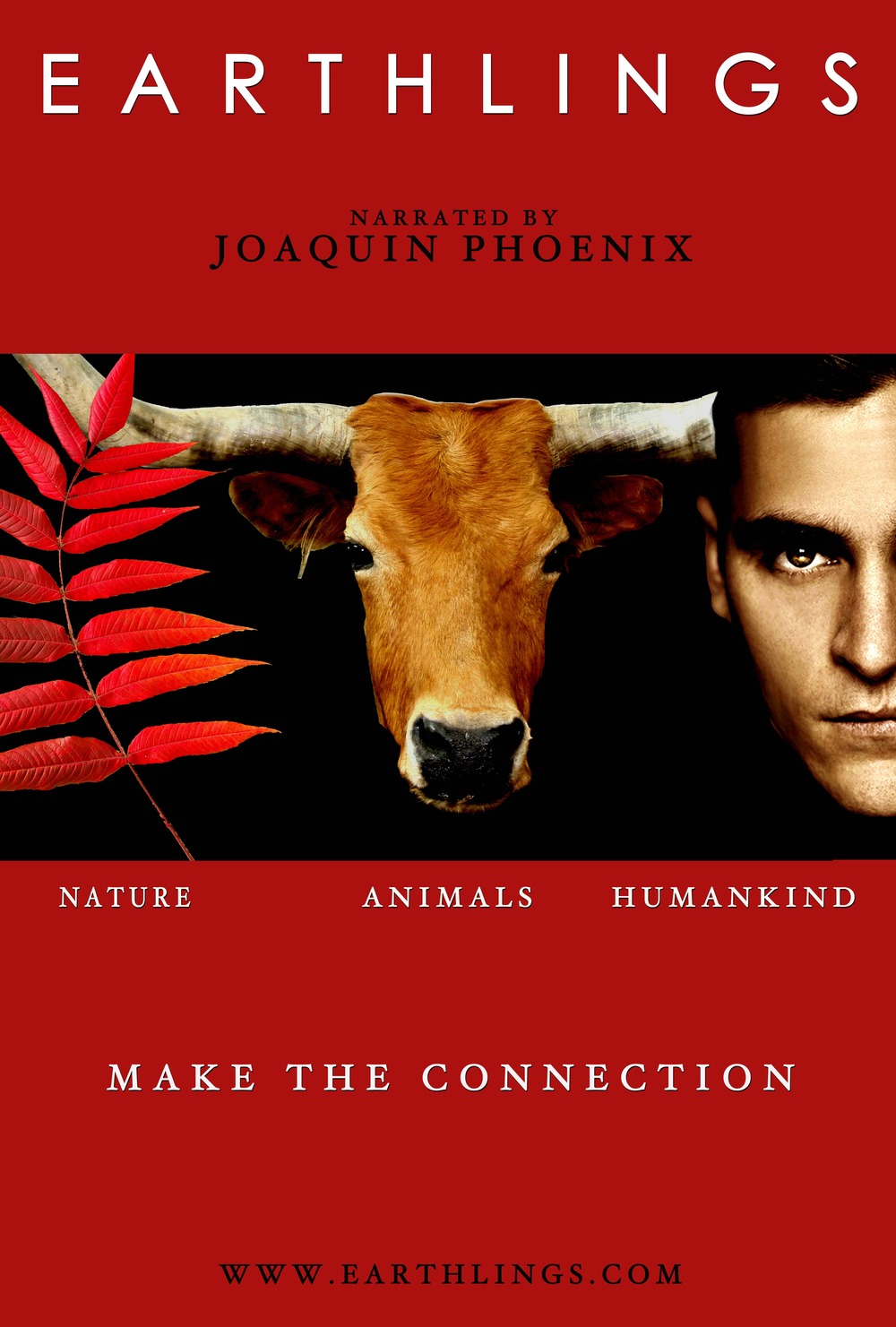
Earthlings (2005) Shaun Monson
Earthlings is a 2005 American documentary film about humanity’s use of other animals as pets, food, clothing, entertainment, and for scientific research. The film is narrated by Joaquin Phoenix, features music by Moby, was directed by Shaun Monson, Executive Produced by Libra Max and was co-produced by Maggie Q, all of whom are vegan.

“It is the human earthling who tends to dominate the earth, often times treating other fellow earthlings and living beings as mere objects. This is what is meant by speciesism. By analogy with racism and sexism, the term speciesism is a prejudice or attitude of of bias in favour of the interest in members of ones own species, and against those members of other species. If a being suffers there can be no moral justification for refusing to take that suffering into consideration. No matter what the nature of the being, the principle of equality requires that one suffering can be treated equally with the like suffering of any other being.”
Earthlings (2005).


Notes:
- Allowing the interest of ones own species to override the interests of other species.
- Themes of objectification: ‘something vs someone’
- “Humans who have power exploit those who lack it “
- Discusses the differences and similarities between humans and animals: comprehension, desires for avoidance of pain, freedom of movement, consciousness, awareness,
- Psychological centres of a life that is uniquely their own
- Film demonstrates in 5 ways, the ways in which just how animals have come to serve mankind
- 1). Pets: companionship: breeders, pet mills, strays, 25m animals become homeless ever year. 9 million die on the street due to hunger, disease, injury, expose or any other hazards. 27% purebred dogs among the homeless. 16 million die in pounds or shelters with no room 50 animals in shelters are turned in by care takers. 60,000 animals euthanised by owners. gas chambers used in pounds due to budget constraint – take as long as 20 minutes to die.
- The overwhelming majority of people take an active part acquiescing and allow their taxes to pay for practices which require the sacrifice of the most important interests of other species in order to promote the most trivial interest of our own species. boiling and hair removal: many are still alive during this process
- “The hope for the animals tomorrow is found in a human culture which learns to feel beyond itself.”
- 2). Food: branding, dehorning without aesthetic, transportation, milking, antibiotics, KOSCHER: rules require minimal suffering, veal: taken from mother 2 days after birth, denied bedding, light, water, exercise in order to keep meat soft. Pigs: stress/ boredom educed cannibalism, tail docking, ear clipping, teeth cutting, castration without anaesthetic: animals have to be adapted to accommodate poor living conditions which result in cannibalism and tail biting.
- Poultry: 8.5 million birds slaughtered every week un the US, debeaking preventing feather pecking, unable to establish social order, denied natural instincts.
- “If slaughter houses had glass walls, would we not all be vegetarians?”
- Ralph Waldo Emerson: “You have just dined, and however scrupulously the slaughterhouse is concealed in the graceful distance of miles, there is complicity.”
- Seafood: commercial fishing, pollution, emptying the ocean of sea life at an alarming rate due to increased demand for fish.
- Pfiesteria outbreak due to hog faeces killed over 1 billion fish – one of the worst outbreak level 3 biohazard, due to industrial scale animal farming.
- 3). Clothing: leather, health effects and human rights issues in tanneries
- fur: cage madness, killing: no laws anal electrocution
- Mark Twain: “Of all the creatures that were made he [man] is the most detestable. Of the entire brood he is the only one — the solitary one — that possesses malice. That is the basest of all instincts, passions, vices — the most hateful… He is the only creature that inflicts pain for sport, knowing it to be pain… Also — in all the list he is the only creature that has a nasty mind.“
- 4). Entertainment: rodeos, circuses,, asserting dominance, fear of punishment, zoos,
- Hunting
- Misconception that fish don’t feel pain.
- 5). Science: vivisection: allegedly to find cure to human illnesses: results: errors in understanding: assumption that results obtained on animals are not directly applicable to humans, concerns the inevitable fallacy of experimental science in respect of the field of organic life. military research, head injury simulations.
- “As long as there are slaughterhouses, there will be battlefields”. – Leo Tolstoy.
- Ignorance is the speciesism first line of defence.
Isaac Bashevis Singer, Enemies, a Love Story 1966: parallels between the holocaust and animal use.
“As often has Herman had witnessed the slaughter of animals and fish, he always had the same thought: In their behaviour toward creatures, all men were Nazis. The smugness with which man could do with other species as he pleased exemplify the most extreme racist theories the principle that might is right.”
The Outermost House Henry Beston (1928) –
“We need a better and wiser and perhaps more mystical concept of animals … For the animal shall not be measured by man. In a world older and more complete than ours, they move finished and complete, gifted with extensions of the senses we have lost or never attained, living by voices we shall never hear… They are not brethren, they are not underlings… they are other nations, caught with ourselves in the net of life and time, fellow prisoners of the splendour and travail of the earth.”
Every Argument Against Veganism | Ed Winters | TEDxBathUniversity
The Socratic Method?
Discusses the cliched arguments made against veganism such as ‘personal choice’.
Exploring the experience of the vegan journey through an animation based narrative.
Speciesism Through a Linguistic Methodology:
How are speciesism attitudes perpetuated by violent animal idioms, similes and phrases.
Animalogy: Change your language. Change the world. | Colleen Patrick-Goudreau | TEDxDupreePark
The Earthshot Prize: Repairing our Planet. (2021)

Critical analysis
After watching ‘The Meat Issue’ section of The Earthshot Prize documentary, I was pleased that animal agriculture was acknowledged as the largest contributory to climate change, however I was disappointed and underwhelmed that the solution was only framed as the ‘reduction’ of meat eating rather than the avoidance of meat and dairy in general. This to me reiterated that plant based eating and veganism is still hugely controversial as despite the knowledge that animal agriculture is so harmful to the planet, the mainstream media still avoids that possibility of giving it up all together. After critically analysing the documentary ‘Earthlings’, which explores the notion of speciesism through the lens of humans bias towards the interests of our own species and trivial needs, it raised the question to me of how our own self interest dictates our response to climate change. How much are we willing to sacrifice for our planet? Despite the boom in satisfying plant based alternatives meat eating remains a cultural tradition that the majority of people are unwilling to re evaluate. This inspired me to consider the normalisation of veganism in my self directed project, and the inseparable relationship between animal rights and environmental issues. The theme of self interest was also emphasised by the section covering conservation of the rhino. The conservation of exotic species seem to be driven by a desire for our children to see them, rather than for the interest of the animal. In this way the documentary expresses a speciesist perspective in its romantic bias towards protecting the rhino, and unwillingness to fully give up harmful and unethical farming practices in the uk.
Classism and Climate Change.
This theme continues in the episodes section on the Democratic Republic of Congo, where the Pole Pole Foundation is helping to protect the local population of gorillas from bush meat poaching by encouraging a plant based diet. The bush meat trade is driven by poverty and an inability to afford alternative healthy meals. This to me epitomised inherent classism and inequality in the discussion of climate change, as although bush meat poaching and industrial farming have different ethical connotations, they both have environmental consequences, yet the poorer populations of the Democratic Republic of Congo are embracing veganism, yet the first world majority are not. In the same way, the recent climate change conference in Italy raised awareness to the human rights issues within the issue of climate change, as the poorer regions who have contributed the least to environmental damage will suffer the most from extreme weather conditions such as tsunamis, droughts and food shortages.
Positivism
https://www.livekindly.co/positive-vegan-messaging-proves-most-effective/
What have we here? (English version) | Help Dad | Oatly
Difficult age (English version) | Help Dad | Oatly
Jacqueline Traide: Social Sculpture
Performance Artist Jacqueline Traide endured 10 hours of experiments to challenge public apathy about animal testing as part of a worldwide campaign by Lush Cosmetics and The Humane Society.

From Jaqueline Traide:
“It was in trepidation that I took on board this performance but not without respect or understanding of its potential, diverse and far reaching affect. I am not only a performance artist but also a teacher, a woman, a friend, a consumer, a feminist, a victim of sexual abuse, a student and most of all a fellow human being. A human who seeks to work for freedom through all of my identities. It was somewhere after the fourth hour of this live act that I found my self asking the question ‘why exactly am I here?’. I realised then that it was not to lush, nor to the onlookers but to the beings, animals and humans alike, that endure such suffering without choice. I am very aware of the consequences arising out of such a performance and feel it is of great important to stimulate and bring new perspectives and awareness on all levels.
I hope that the emotions and opinions the performance has provoked in people will inspire people to channel these energies into going out and fighting for all these injustices in the world through art, live action, performance, theatre, dance and music as well as an expression through debate – for if not through diverse mediums and the coming together through our many identities and creativity will these things can be changed?”
Workshop Challenge
This week you will explore potential visual directions for your self-initiated project.
- Design five different mood boards to clearly demonstrate how you might research, develop and apply your self-initiated project.
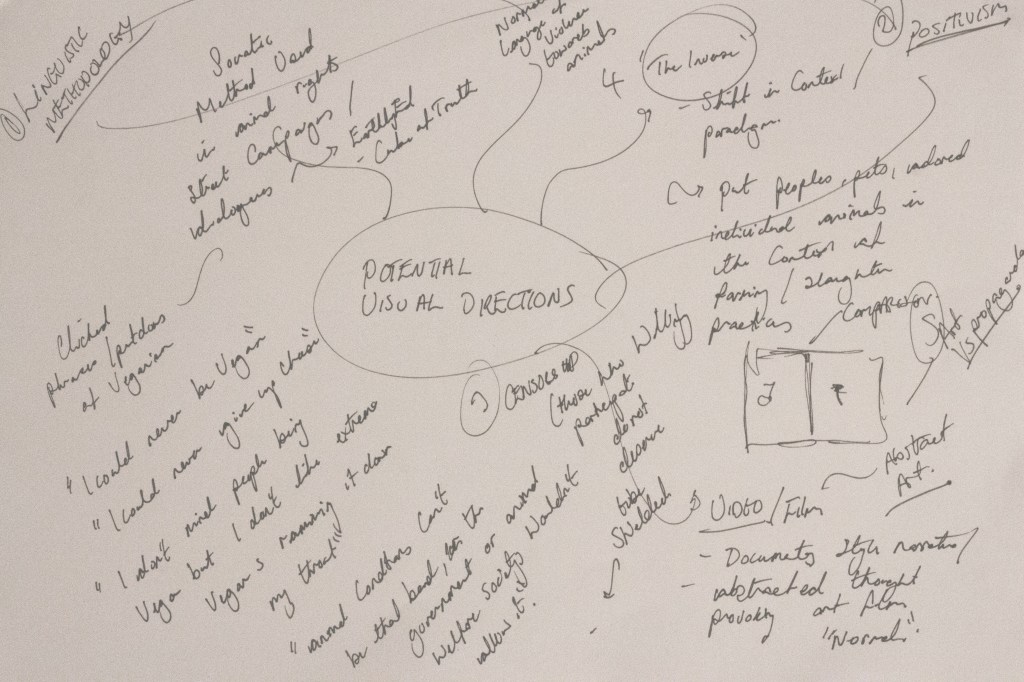
- Upload your five mood board visuals to your blog, with accompanying text captions, to clearly outline the points of reference, inspiration, visual direction and design rationale.
- Select one preferred mood board and upload it to the Ideas Wall and include a brief design rationale, to gain peer feedback.
- Select one direction for your self-initiated project (chosen from one of your five mood boards) and announce your intentions on the Ideas Wall.
- Develop five initial rough visuals in response to your self-initiated project brief. Your rough visuals can be a sketch, design mock up or rendering.
- Post your five initial visuals onto the Ideas Wall, to gain peer reflection.
Mood Board 1). Positivism
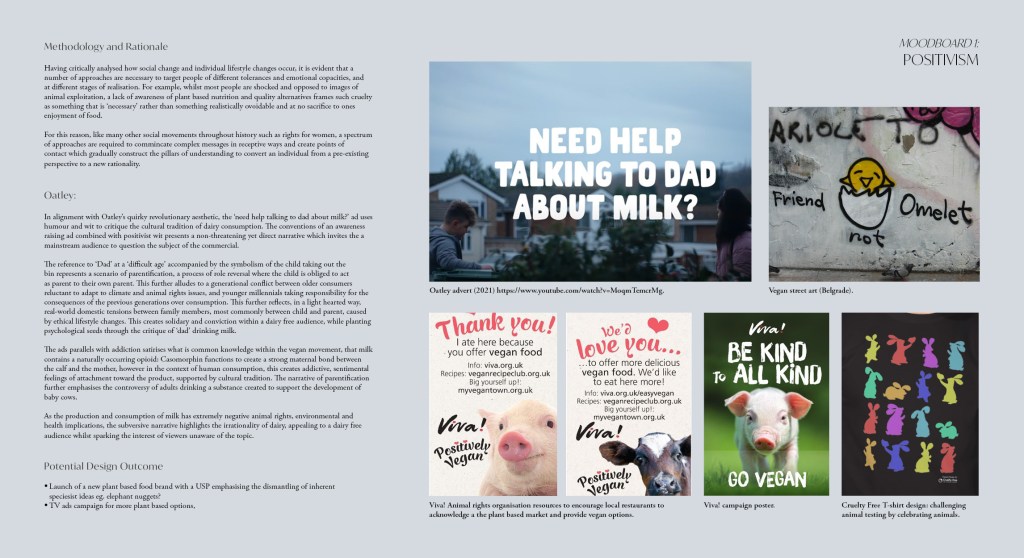
Methodology and Rationale
Having critically analysed how social change and individual lifestyle changes occur, it is evident that a number of approaches are necessary to target people of different tolerances and emotional copacities, and at different stages of realisation. For example, whilst most people are shocked and opposed to images of animal exploitation, a lack of awareness of plant based nutrition and quality alternatives frames such cruelty as something that is ‘necessary’ rather than something realistically ovoidable and at no sacrifice to ones enjoyment of food.
For this reason, like many other social movements throughout history such as rights for women, a spectrum of approaches are required to commincate complex messages in receptive ways and create points of contact which gradually construct the pillars of understanding to convert an individual from a pre-existing perspective to a new rationality.
Oatley:
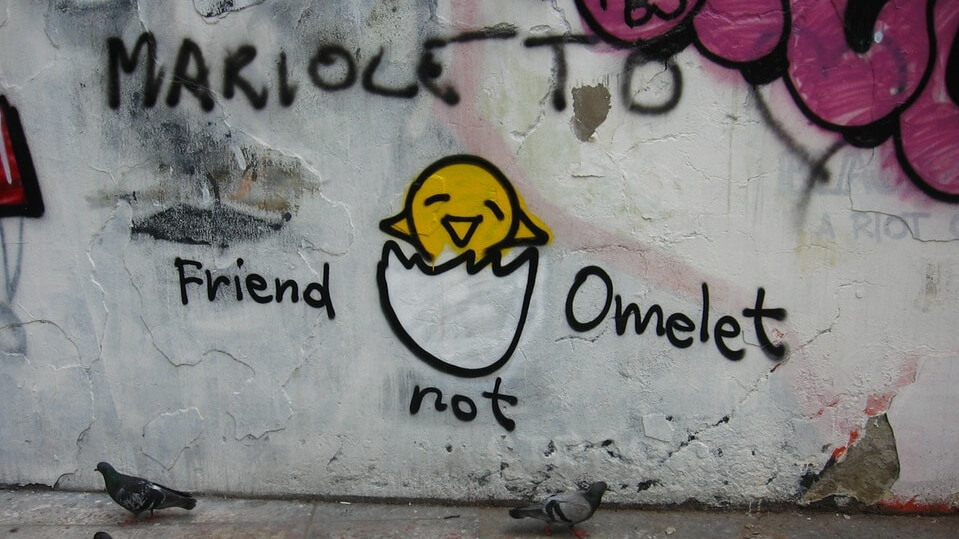
In alignment with Oatley’s quirky revolutionary aesthetic, the ‘need help talking to dad about milk?’ ad uses humour and wit to critique the cultural tradition of dairy consumption. The conventions of an awareness raising ad combined with positivist wit presents a non-threatening yet direct narrative which invites the a mainstream audience to question the subject of the commercial.
The reference to ‘Dad’ at a ‘difficult age’ accompanied by the symbolism of the child taking out the bin represents a scenario of parentification, a process of role reversal where the child is obliged to act as parent to their own parent. This further alludes to a generational conflict between older consumers reluctant to adapt to climate and animal rights issues, and younger millennials taking responsibility for the consequences of the previous generations over consumption. This further reflects, in a light hearted way, real-world domestic tensions between family members, most commonly between child and parent, caused by ethical lifestyle changes. This creates solidary and conviction within a dairy free audience, while planting psychological seeds through the critique of ‘dad’ drinking milk.
The ads parallels with addiction satirises what is common knowledge within the vegan movement, that milk contains a naturally occurring opioid: Casomorphin functions to create a strong maternal bond between the calf and the mother, however in the context of human consumption, this creates addictive, sentimental feelings of attachment toward the product, supported by cultural tradition. The narrative of parentification further emphasises the controversy of adults drinking a substance created to support the development of baby cows.
As the production and consumption of milk has extremely negative animal rights, environmental and health implications, the subversive narrative highlights the irrationality of dairy, appealing to a dairy free audience whilst sparking the interest of viewers unaware of the topic.
Potential Design Outcome
- Launch of a new plant based food brand with a USP emphasising the dismantling of inherent speciesist ideas eg. elephant nuggets?
- TV ads campaign for more plant based options
Mood Board 2). Politics and Design
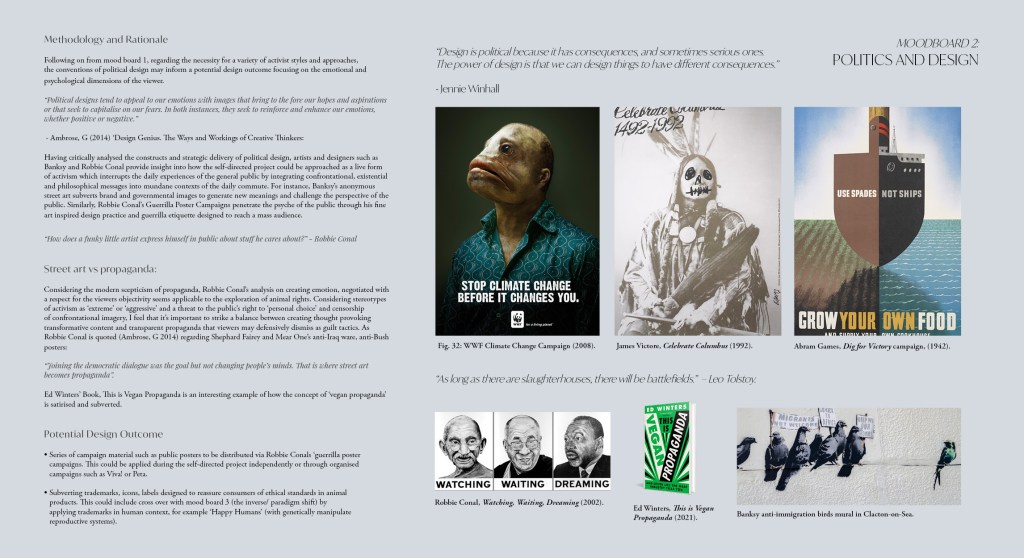
Methodology and Rationale
Following on from mood board 1, regarding the necessity for a variety of activist styles and approaches, the conventions of political design may inform a potential design outcome focusing on the emotional and psychological dimensions of the viewer.
“Political designs tend to appeal to our emotions with images that bring to the fore our hopes and aspirations or that seek to capitalise on our fears. In both instances, they seek to reinforce and enhance our emotions, whether positive or negative.”- Ambrose, G (2014) ‘Design Genius. The Ways and Workings of Creative Thinkers:
Having critically analysed the constructs and strategic delivery of political design, artists and designers such as Banksy and Robbie Conal provide insight into how the self-directed project could be approached as a live form of activism which interrupts the daily experiences of the general public by integrating confrontational, existential and philosophical messages into mundane contexts of the daily commute. For instance, Banksy’s anonymous street art subverts brand and governmental images to generate new meanings and challenge the perspective of the public. Similarly, Robbie Conal’s Guerrilla Poster Campaigns penetrate the psyche of the public through his fine art inspired design practice and guerrilla etiquette designed to reach a mass audience.
“How does a funky little artist express himself in public about stuff he cares about?” – Robbie Conal
Street art vs propaganda:
Considering the modern scepticism of propaganda, Robbie Conal’s analysis on creating emotion, negotiated with a respect for the viewers objectivity seems applicable to the exploration of animal rights. Considering stereotypes of activism as ‘extreme’ or ‘aggressive’ and a threat to the public’s right to ‘personal choice’ and censorship of confrontational imagery, I feel that it’s important to strike a balance between creating thought provoking transformative content and transparent propaganda that viewers may defensively dismiss as guilt tactics. As Robbie Conal is quoted (Ambrose, G 2014) regarding Shephard Fairey and Mear One’s anti-Iraq ware, anti-Bush posters:
“Joining the democratic dialogue was the goal but not changing people’s minds. That is where street art becomes propaganda”.
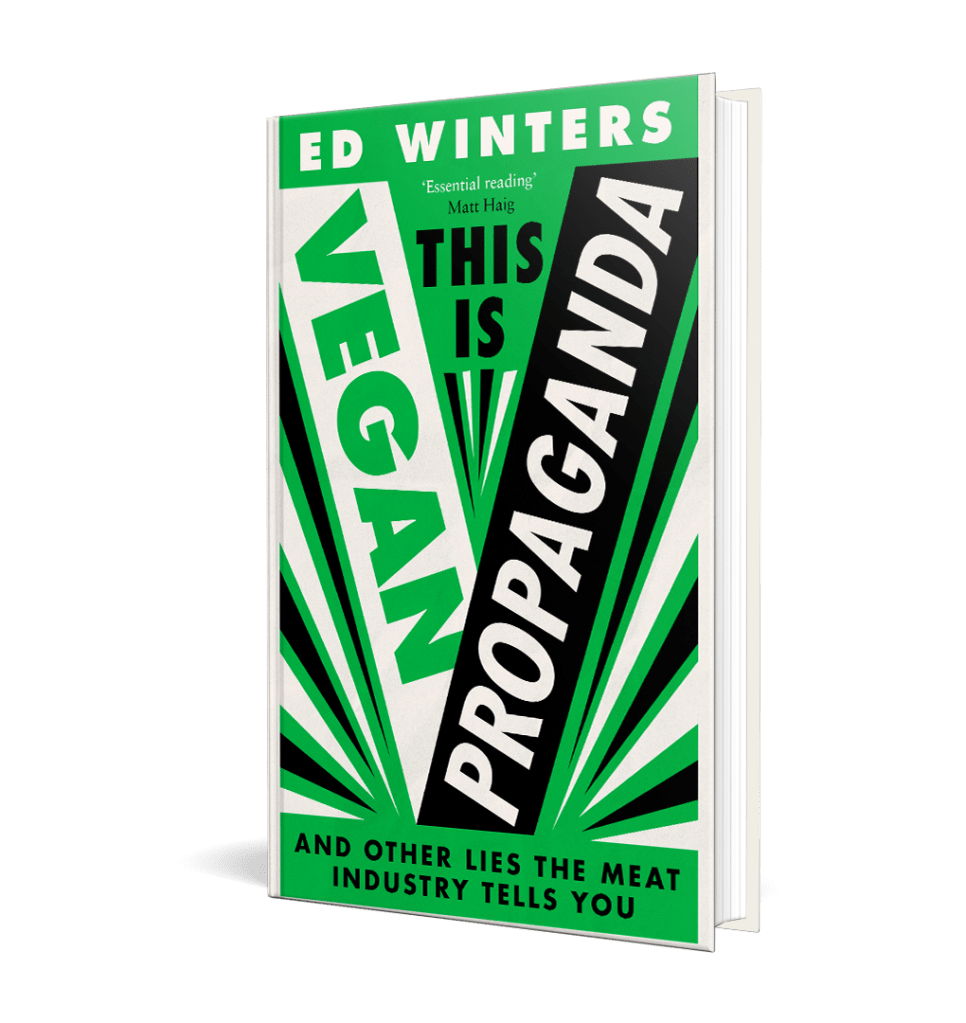
Ed Winters’ Book, This is Vegan Propaganda is an interesting example of how the concept of ‘vegan propaganda’ is satirised and subverted.
Potential Design Outcome
- Series of campaign material such as public posters to be distributed via Robbie Conals ‘guerrilla poster campaigns. This could be applied during the self-directed project independently or through organised campaigns such as Viva! or Peta.
- Subverting trademarks, icons, labels designed to reassure consumers of ethical standards in animal products. This could include cross over with mood board 3 (the inverse/ paradigm shift) by applying trademarks in human context, for example ‘Happy Humans’ (with genetically manipulate reproductive systems).
Mood Board 3). The Inverse: Paradigm Shift
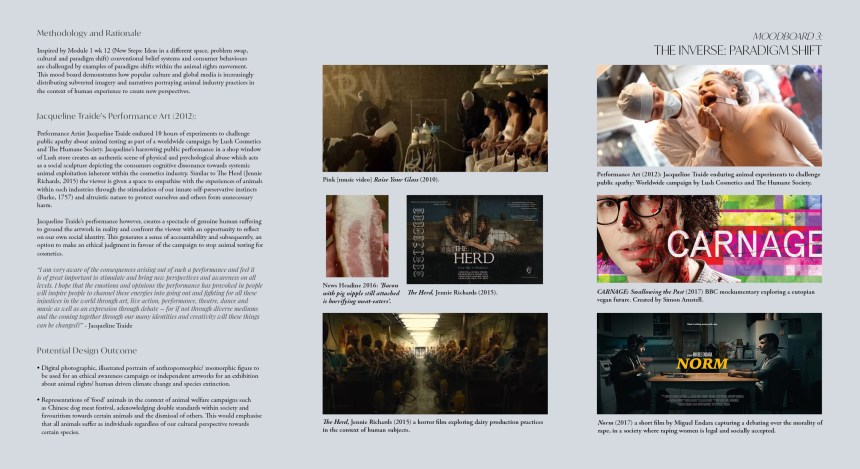
Methodology and Rationale
Inspired by Module 1 wk 12 (New Steps: Ideas in a different space, problem swap, cultural and paradigm shift) conventional belief systems and consumer behaviours are challenged by examples of paradigm shifts within the animal rights movement. This mood board demonstrates how popular culture and global media is increasingly distributing subverted imagery and narratives portraying animal industry practices in the context of human experience to create new perspectives.
Jacqueline Traide’s Performance Art (2012):
Performance Artist Jacqueline Traide endured 10 hours of experiments to challenge public apathy about animal testing as part of a worldwide campaign by Lush Cosmetics and The Humane Society. Jacqueline’s harrowing public performance in a shop window of Lush store creates an authentic scene of physical and psychological abuse which acts as a social sculpture depicting the consumers cognitive dissonance towards systemic animal exploitation inherent within the cosmetics industry. Similar to The Herd (Jennie Richards, 2015) the viewer is given a space to empathise with the experiences of animals within such industries through the stimulation of our innate self-preservative instincts (Burke, 1757) and altruistic nature to protect ourselves and others form unnecessary harm.
Jacqueline Traide’s performance however, creates a spectacle of genuine human suffering to ground the artwork in reality and confront the viewer with an opportunity to reflect on our own social identity. This generates a sense of accountability and subsequently, an option to make an ethical judgment in favour of the campaign to stop animal testing for cosmetics.
“I am very aware of the consequences arising out of such a performance and feel it is of great important to stimulate and bring new perspectives and awareness on all levels. I hope that the emotions and opinions the performance has provoked in people will inspire people to channel these energies into going out and fighting for all these injustices in the world through art, live action, performance, theatre, dance and music as well as an expression through debate – for if not through diverse mediums and the coming together through our many identities and creativity will these things can be changed?” – Jacqueline Traide
Potential Design Outcome
- Digital photographic, illustrated portraits of anthropomorphic/ zoomorphic figure to be used for an ethical awareness campaign or independent artworks for an exhibition about animal rights/ human driven climate change and species extinction.
- Representations of ‘food’ animals in the context of animal welfare campaigns such as Chinese dog meat festival, acknowledging double standards within society and favouritism towards certain animals and the dismissal of others. This would emphasise that all animals suffer as individuals regardless of our cultural perspective towards certain species.
Mood Board 4). Linguistic Methodology
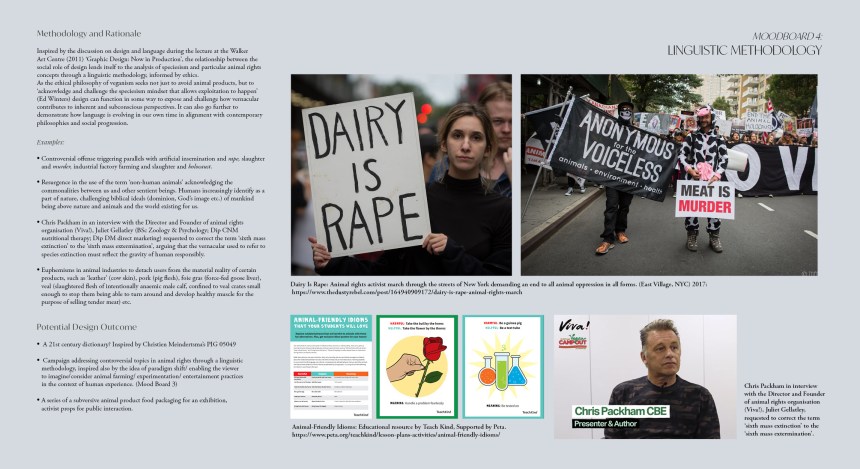
Methodology and Rationale
Inspired by the discussion on design and language during the lecture at the Walker Art Centre (2011) ‘Graphic Design: Now in Production’, the relationship between the social role of design lends itself to the analysis of speciesism and particular animal rights concepts through a linguistic methodology, informed by ethics.
As the ethical philosophy of veganism seeks not just to avoid animal products, but to ‘acknowledge and challenge the speciesism mindset that allows exploitation to happen’ (Ed Winters) design can function in some way to expose and challenge how vernacular contributes to inherent and subconscious perspectives. It can also go further to demonstrate how language is evolving in our own time in alignment with contemporary philosophies and social progression.
Examples:
Controversial offense triggering parallels with artificial insemination and rape, slaughter and murder, industrial factory farming and slaughter and holocaust.
Resurgence in the use of the term ‘non-human animals’ acknowledging the commonalities between us and other sentient beings. Humans increasingly identify as a part of nature, challenging biblical ideals (dominion, God’s image etc.) of mankind being above nature and animals and the world existing for us.
Chris Packham in an interview with the Director and Founder of animal rights organisation (Viva!), Juliet Gellatley (BSc Zoology & Psychology; Dip CNM nutritional therapy; Dip DM direct marketing) requested to correct the term ‘sixth mass extinction’ to the ‘sixth mass extermination’, arguing that the vernacular used to refer to species extinction must reflect the gravity of human responsibly.
Euphemisms in animal industries to detach users from the material reality of certain products, such as ‘leather’ (cow skin), pork (pig flesh), foie gras (force-fed goose liver), veal (slaughtered flesh of intentionally anaemic male calf, confined to veal crates small enough to stop them being able to turn around and develop healthy muscle for the purpose of selling tender meat) etc.
Potential Design Outcome
- A 21st century dictionary? Inspired by Christien Meindertsma’s PIG 05049
- Campaign addressing controversial topics in animal rights through a linguistic methodology, inspired also by the idea of paradigm shift/ enabling the viewer to imagine/consider animal farming/ experimentation/ entertainment practices in the context of human experience. (Mood Board 3)
- A series of a subversive animal product food packaging for an exhibition, activist props for public interaction.
Mood Board 5). Exposé/ The uncensored
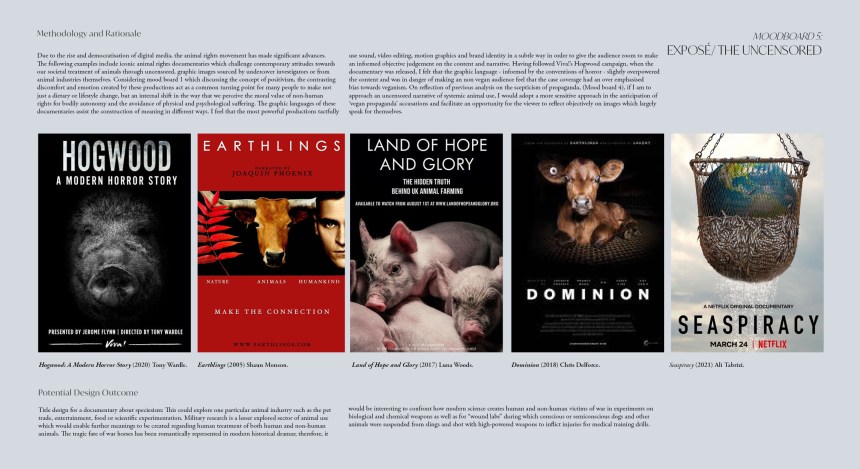
Methodology and Rationale
Due to the rise and democratisation of digital media, the animal rights movement has made significant advances. The following examples include iconic animal rights documentaries which challenge contemporary attitudes towards our societal treatment of animals through uncensored, graphic images sourced by undercover investigators or from animal industries themselves. Considering mood board 1 which discussing the concept of positivism, the contrasting discomfort and emotion created by these productions act as a common turning point for many people to make not just a dietary or lifestyle change, but an internal shift in the way that we perceive the moral value of non-human rights for bodily autonomy and the avoidance of physical and psychological suffering. The graphic languages of these documentaries assist the construction of meaning in different ways. I feel that the most powerful productions tactfully use sound, video editing, motion graphics and brand identity in a subtle way in order to give the audience room to make an informed objective judgement on the content and narrative. Having followed Viva!’s Hogwood campaign, when the documentary was released, I felt that the graphic language – informed by the conventions of horror – slightly overpowered the content and was in danger of making an non vegan audience feel that the case coverage had an over emphasised bias towards veganism. On reflection of previous analysis on the scepticism of propaganda, (Mood board 4), if I am to approach an uncensored narrative of systemic animal use, I would adopt a more sensitive approach in the anticipation of ‘vegan propaganda’ accusations and facilitate an opportunity for the viewer to reflect objectively on images which largely speak for themselves.
Potential Design Outcome
Title design for a documentary about speciesism: This could explore one particular animal industry such as the pet trade, entertainment, food or scientific experimentation. Military research is a lesser explored sector of animal use which would enable further meanings to be created regarding human treatment of both human and non-human animals. The tragic fate of war horses has been romantically represented in modern historical dramas; therefore, it would be interesting to confront how modern science creates human and non-human victims of war in experiments on biological and chemical weapons as well as for “wound labs” during which conscious or semiconscious dogs and other animals were suspended from slings and shot with high-powered weapons to inflict injuries for medical training drills.
Develop five initial rough visuals in response to your self-initiated project brief.
Your rough visuals can be a sketch, design mock up or rendering.
Post your five initial visuals onto the Ideas Wall, to gain peer reflection.
1). Awareness campaign about the instrinsic commonalities between human and non human animals: series of posters, videos enabling the creating of a brand identity and other marketing materials
can explore invererse imagery re human and animals, meat paintings, annotated anatomical designs representing similar body parts, brain functionalities: humans – dogs – pigs in a hieracy of percieved moral vale

 CATHY DAVIES